Friday, January 24, 2014

The Strange Case of the Ramen Girl

"Teach a man to fish, and you feed him for a lifetime. Give him ramen noodles, and you don’t have to teach him anything."  Lawrence Downes


A few months ago, "The Ramen Girl" popped up on our recorder. We set it for something else but the schedule was changed.  After we watched the film for a few minutes, we ended up wholly engaged and found it pretty entertaining...mostly the sets and mostly the noodle shop.  Because I have noodles on the brain, I thought I'd look up the film's rating and see how the young star's career fared. 

I was shocked to read that the lovely and talented young (32 years old) Brittany Murphy died in 2009 under strange circumstances. See the Wikipedia information below. Even more strange is that her husband (also 32) died a scant 3 months later from a similar cause! You wonder what happens to cases like this....is somebody trying to figure out what happened? 

At 08:00 (16:00 GMT) on December 20, 2009, the Los Angeles Fire Department responded to "a medical request"[35] at the Los Angeles home Murphy and Monjack shared. She had apparently collapsed in a bathroom.[6] Firefighters attempted to resuscitate Murphy on the scene. She was transported to Cedars-Sinai Medical Center, where she was pronounced dead on arrival[36] at 10:04 after going into cardiac arrest.[6][35]
Shortly after her death, Assistant Chief Coroner Ed Winter told the Associated Press: "It appears to be natural."[10][37][38] An autopsy was performed the day after she died. Her death certificate listed the cause of death as "deferred".[39] On February 4, 2010, the Los Angeles County coroner stated that the primary cause of Murphy's death was pneumonia, with secondary factors of iron-deficiency anemia and multiple drug intoxication. On February 25, 2010, the coroner released a report stating that Murphy had been taking a range of over-the-counter and prescription medications, with the most likely reason being to treat a cold or respiratory infection. These included "elevated levels" of hydrocodoneacetaminophenL-methamphetamine and chlorpheniramine. All of the drugs were legal and the death was ruled to be an accident, but the report observed: "the possible adverse physiological effects of elevated levels of these medications cannot be discounted, especially in her weakened state."[2]
Murphy was buried at Forest Lawn Hollywood Hills on December 24, 2009.[40]
On May 23, 2010, her widower Simon Monjack was found dead at the same Hollywood Hills residence.[41] In July 2010, Los Angeles Assistant Chief Coroner Ed Winter stated that the cause of his death was acute pneumonia and severe anemia.[42] It was reported that the Los Angeles County Department of Health had considered toxic mold in their house as a possible cause of the deaths, but this was dismissed by Ed Winter, who stated that there were "no indicators" that mold was a factor.[43] Murphy's mother Sharon described the reports of mold contributing to the deaths as "absurd" and went on to state that inspecting the home for mold was never requested by the Health Department.[44] In December 2011, Sharon Murphy changed her stance, announcing that toxic mold was indeed what killed her daughter and son-in-law, and filed a lawsuit against the attorneys who represented her in an earlier suit against the builders of the home where her daughter and son-in-law died.[45]
On January 11, 2012, her father Angelo Bertolotti applied to the Superior Court of California requesting that the Los Angeles County Coroner's Office be required to hand over samples of his daughter's hair for independent testing.[46][47] The suit was dismissed on July 19, 2012 after Bertolotti failed to show up to two separate hearings.[48]
In November 2013, Angelo Bertolotti claimed that a toxicology report showed that deliberate poisoning by heavy metals, including antimony and barium, was a possible cause of Brittany Murphy's death. Sharon Murphy described the claim as "a smear".

The Happy Story of Mr. Noodle

By contrast and on a happier note, here's a piece from the New York Times written about the inventor of the instant Ramen noodle product, Mr. Momofuku Ando, who lived to be 96 - three times as long as the Ramen girl and her unlucky husband. 

Did he ever cut a noodle? I think not.


APPRECIATIONS

Mr. Noodle

The news last Friday of the death of the ramen noodle guy surprised those of us who had never suspected that there was such an individual. It was easy to assume that instant noodle soup was a team invention, one of those depersonalized corporate miracles, like the Honda Civic, the Sony Walkman and Hello Kitty, that sprang from that ingenious consumer-product collective known as postwar Japan.


Kyodo News, via Associated Press
Momofuku Ando in 2005.

But no. Momofuku Ando, who died in Ikeda, near Osaka, at 96, was looking for cheap, decent food for the working class when he invented ramen noodles all by himself in 1958. His product — fried, dried and sold in little plastic-wrapped bricks or foam cups — turned the company he founded, Nissin Foods, into a global giant. According to the company’s Web site, instant ramen satisfies more than 100 million people a day. Aggregate servings of the company’s signature brand, Cup Noodles, reached 25 billion worldwide in 2006.
There are other versions of fast noodles. There is spaghetti in a can. It is sweetish and gloppy and a first cousin of dog food. Macaroni and cheese in a box is a convenience product requiring several inconvenient steps. You have to boil the macaroni, stir it to prevent sticking and determine through some previously obtained expertise when it is “done.” You must separate water from noodles using a specialized tool, a colander, and to complete the dish — such an insult — you have to measure and add the fatty deliciousness yourself, in the form of butter and milk that Kraft assumes you already have on hand. All that effort, plus the cleanup, is hardly worth it.
Ramen noodles, by contrast, are a dish of effortless purity. Like the egg, or tea, they attain a state of grace through a marriage with nothing but hot water. After three minutes in a yellow bath, the noodles soften. The pebbly peas and carrot chips turn practically lifelike. A near-weightless assemblage of plastic and foam is transformed into something any college student will recognize as food, for as little as 20 cents a serving.
There are some imperfections. The fragile cellophane around the ramen brick tends to open in a rush, spilling broken noodle bits around. The silver seasoning packet does not always tear open evenly, and bits of sodium essence can be trapped in the foil hollows, leaving you always to wonder whether the broth, rich and salty as it is, is as rich and salty as it could have been. The aggressively kinked noodles form an aesthetically pleasing nest in cup or bowl, but when slurped, their sharp bends spray droplets of broth that settle uncomfortably about the lips and leave dots on your computer screen.
But those are minor quibbles. Ramen noodles have earned Mr. Ando an eternal place in the pantheon of human progress. Teach a man to fish, and you feed him for a lifetime. Give him ramen noodles, and you don’t have to teach him anything.
LAWRENCE DOWNES


Wednesday, January 22, 2014

Envelope Soup

 "What Contemptible Scoundrel Stole The Cork From My Lunch" --- W.C. Fields

My mother loved "envelope soup" - her name for Lipton's dehydrated chicken noodle soup.
On cold winter days, we'd come home from school for lunch, bursting in the back door out of the -30 or -40 degree cold shouting urgently,  "Mom, I'm starving!" We didn't have to wait long - just the time it took to shrug out of the snow suits, undo the boots, shake them off and run to the table that was squeezed into the corner of the kitchen. (My closet is bigger than that kitchen was). She'd have a grilled cheese sandwich and a bowl of hot soup waiting. I didn't know, of course, how good I had it. Our youthful appetites were intensified by the freezing weather; the food was lovingly prepared and offered in our warm kitchen; life was uncomplicated (at least for the kids) and we were safe. Happy. My mother would stand by the stove, waiting for me to finish one bowl so she could add more and she'd patiently listen to me babble about the morning at school. It must have been thrilling for her to hear all the things that went on in the second grade. Even after a career in the food business and after eating delicacies all over the world, few things have ever tasted as good as those warm winter lunches and never, ever has there been a listener like my Mom. Except perhaps for your Mom?

I've been thinking about those soup lunches as I've been mapping out our food forays coming up in Japan. First thing in Japan you have to consider is Ramen, Ramen, Ramen. 

It was easy to eat "envelope soup". The inch long, firm noodles were easy to get into a spoon and they'd obediently stay in the spoon until you could get them into your mouth. Even a kid could manage it. 

Moving upscale once in a while, my mother would substitute a bowl of Campbell's canned chicken noodle soup for the envelope variety. The Campbell's noodles were plumper and longer - harder to handle. We'd crouch over our bowls and suck up the noodles, much to my mother's chagrin. She'd insist we suck quietly or we cut the noodles with our spoons. Of course that encouraged us to slurp all the louder.

During the course of my Ramen Reading, I've learned/affirmed that in most of Asia, it's considered bad luck to cut a noodle. A noodle is considered a "life line" and cutting it is not advised. Asians slurp assisting consumption with a deep, flat soup spoon used for the broth and in a minor way to help get the noodles within slurping distance of the mouth.  Noisily and enthusiastically they slurp; the more the better. And not just for the sake of good manners. Even though slurping is complimentary to the chef and conveys satisfaction and happiness, slurping improves the taste. The action helps get soup around in the mouth to all taste receptors; it causes volatiles to travel up through the nose to odor receptors; it increases the flow of saliva and it serves to slightly cool the soup before it goes down the throat. All good things. 

Here's an interesting presentation of Ramen....it's in Kyoto and if we can remember to pack our flak jackets, maybe we'll visit the place. You have to be very careful not to make a fuss???? 


Tuesday, January 14, 2014

The Orphan Master's Son and "The Lady in Gold"

This month our book club read "The Orphan Masters Son", the 2013 winner of the Pulitzer prize for fiction.


Set in North Korea, it's an epic tale and absolutely riveting.  While reading reviews of the book and lists of honors the author has won, I noticed he (Adam Johnson) won the California prize for fiction. I'd never heard of it but on their web site I noticed that the 2013 award for non-fiction went to Anne Marie O'Connor for "The Lady in Gold: The Extraordinary Tale of Gustav Klimt's Masterpiece, Portrait of Adele Bloch-Bauer." As we just saw "The Kiss" in Vienna and as I have SADD (senior attention deficit disorder) my attention was totally diverted.

"The Lady in Gold" feels like a good old friend as I once spent a few weeks assembling a jig saw puzzle of the work.

As you can see my paltry art education has been acquired in the most plebeian of ways, although in all fairness, I must say the puzzle was an authorized one purchased when the painting was here in Southern California some years ago. Not some cheapo knock off.

Puzzles made of famous works aren't the worst thing that can happen. In the Belvedere museum in Vienna where we saw the "Kiss", they've merchandised the heart and soul of poor Gustav. His images are on everything; we watched the museum shop cash registers smoking: they were selling place mats and ties; napkins and book marks;scarves and calendars; diaries and notebooks. Richard bought a eye glass case and a couple of prints but I resisted buying even one of the Klimt books - the big heavy coffee table books I love but hate hauling home. There is something unbelievably compelling in those museum shops; we rarely leave without some knick knack and most of the time we regret that we can't carry home more. Of course, the merchandising is essential to providing funds for museum support which helps ease the pain and guilt of plucking tissues from your Klimt Kleenex holder.


Something strange comes over us in museums; something we both like. I think we fall "in love" with these works of art, to over simplify. They're not considered masterpieces without reason. Once under their spell, you want to have something to remember them by; you want to stay connected even if it's through the reproduction on your mouse pad or your coffee mug.


Klimt, they say, was inspired by the Byzantine era gold leaf paintings. perhaps like the by Giottos hanging in our own backyard at the Getty. I'll have to further educate myself in the Byzantine by buying a puzzle of one of these beauties.
Wikipedia. Giotto di Bondoni

And speaking of inspiration I'm motivated to read the O'Connor book if I can ever haul
myself mentally out of North Korea.


Friday, January 10, 2014

Expensive in Vienna

We have a couple of Buddah's Hands or Citron trees growing just for novelty and they are quite fecund.  Or is it prolific? I think of "prolific" in terms of accomplishment and "fecund" as a more biological description. Even after looking the usage up, I'm still not sure. In every day terms, people seem to use them interchangeably. 

I was surprised to find out how expensive the fruit is in Europe. You'd better have a fecund bank account if you want to purchase many of these. 

35.90 euro/ kilo or 16 euro per pound = about $22 per pound. Usually we just let them fall to the ground. I'm inspired to try candying a few. 

Suggested uses for Citron from Tastylandscapes.com

Buddha Hand Citron Fruit Use:

Zest:
In the western culinary world, the fruit is mainly used for its aromatic rind.  The rind makes a great zest, much better than lemon in my opinion. Specific culinary usages range from flavoring savory dishes, desserts and vodka.
The insides:
The inside of the fruit is composed almost entirely the white stuff (pith) that you see between an orange rind and orange flesh. However, here the white stuff is much firmer and has been called solid albedo.  There is really nothing juicy in there.  No seeds either. However, you can eat this white stuff inside after you remove the bitter outer yellow rind.  The albedo has a very mild floral flavor and is on the dry side.  None the less, it can be cut in slices to add some texture to salads, etc.
Candied:
The fruit is pulled apart into individual fingers, dried and candied.  This candied fruit is a popularsnack throughout Asia.
Air freshener:
Many simply use the fruit as an air freshener for the car or home-doubling as a conversation piece. The citron smell that is released from the fruit is a delight. The aroma reminds me of thecereal fruity pebbles and fruit loops, without the artificial overtones.  Others say it smells like violets.
Gift:
The plant has a long history in China where it is highly prized because it symbolizes long life hand happiness. In Japan, the fruit is a popular gift at New Year’s because it’s believed to bringgood fortune to a home.
Religious offering:
The fruit is sometimes given as an offering in Buddhist temples.   The fruit with a closed hand configuration is the most valued for offerings because in this state it resembles the Buddhist hand gesture for prayer.
Medicine:
In Asia, it has been prescribed as a tonic as part of traditional medicine.

Vape anyone?


Finally getting the last few travel items put away, I got to the very bottom of my back pack and found this:


I looked at it for a while, drawing a blank, and showed it to Richard. Neither of us had ever seen the item before. There's a light thingie on one end so we thought maybe it was a flashlight. Finally I was looking at it from a different angle and realized it looked like a cigarette. "Gamucci" is written on the side of the thing and a Google search reveals that it is indeed a Ecigarette. Puffing on it causes the light to turn on, sort of glow and it generates some simulated smoke.
Vaping utilizes a Propylene Glycol or Vegetable Glycerin based liquid, mixed with small amounts of nicotine and food grade flavoring that then get vaporized in a small battery powered atomizer. Simulating the experience of smoking, the vapor created is inhaled and exhaled much like cigarette smoke hence the term “VAPING” as opposed to “SMOKING” 

How did it get in my backpack? We had to check our packs at some of the museums in Vienna, which is the only time mine would have been out of my sight. Perhaps someone accidentally dropped it in? Or is it some devilishly clever marketing ploy. Reverse theft? 

It was a reminder to periodically examine the contents of my back pack when on the road...not for items stolen but for items planted.
Scary thought. 

Sepia Saturday 210: "He is still moving Mr. Mu."


"Things found in old books" is the theme for this week's Sepia Saturday. Nancy told me about an exhibit of such items that the Fallbrook Library put together. Can you imagine the stories behind all the notes, photos, documents left in library books? 

I started going through Richard's old books because he has a habit of using interesting things for book marks; foreign currency for example.  He enjoys finding the bills years later and being reminded of times past, like when Zimbabwe was experiencing 89,000,000,000,000,000,000% inflation. 


He also uses old envelopes, receipts and airline tickets. My own books don't yield much flotsam or jetsam; I'm a book torturer and fold down the corners to mark my spot. I apologize for that. 

Peering at the line-up of books on the shelf, I could see something white sticking up from the pages of his  "Lin Yutang's Chinese-English Dictionary of Modern American Usage". 


Instead of the worthless but amusing 100 trillion dollar Zimbabwe bank note, this photo fluttered out.

When I showed it to Richard he started to laugh. "What's so funny?" I queried. The photo was marked DIA and bore an official looking number; I assumed it was probably something serious. As the laughter subsided, I asked all my questions, beginning with, "Who was Mr. Mu?".

My husband had a career working in various aspects of intelligence gathering: At one point he was on assignment in an east european country attending an exhibition of Finnish skiing skills and "watching" a Chinese diplomat who was also "watching" him. It's a long complicated story - too long for this purpose. The two adversaries ended up looking at each other face to face and camera to camera. It was a comic situation and my husband has a fine sense of humor. In a spontaneous flash of fun, they laughingly agreed to switch cameras and take pictures of each other. Guess who suggested this? Once "Mr. Mu" handed Richard his camera, Richard absconded with it. In that game there's little room for spontaneity. Shame on Mr. Mu; he should have known better. 

After the incident was over, one of Richard's associates at DIA slipped him this bucolic photo, with the added caption, of a Chinese man using some kind of instrument. Were Chinese intelligence agents so naive and inept; so unschooled in spy craft, like poor Mr. Mu, that they'd use a device on a tripod in the middle of an empty field and have an assistant? That's the joke of course. 

As you can see the photo is stamped unclassified and unlike most memories of those times, Richard was able to keep it and use it as a book mark. 

I love watching spy movies with my husband who has his best laughs when the crucial file (there's always one) is handed over from one person to the next and lest we, the great unwashed, don't get it, it's stamped in the most clandestine possible way: 
"TOP SECRET"  

Don a disguise!.... something low-key like a nose-and-glasses 

......and sneak on over to Sepia Saturday to read more stories.


Optional theme music by the great Henry Mancini.....


Monday, January 06, 2014

The Downton Electric Mixer

Here's the New Yorker's review of the season four opener of the Downton Abbey series last night. I fell asleep. I found Mary, mourning for six months, pale, thin and barely interested in her son, a crashing bore. With all the robust and well drawn characters in the mix, I'm gob smacked at why the writers couldn't have done better

This season’s slightly feminist and pro-labor gambits notwithstanding (several side plots have been established about highly trained servants being forced out of their jobs), the show not-so-implicitly argues that although circumstances evolve, solid family values will endure. Especially if you have kindly old servants watching your back. The show’s plummy, self-satisfied conservatism has been pointed out 
many times before. But that won’t stop me from rooting for Mary, the newly-hatched Downton executive. Please pass the excellent, electric-mixer-made pudding, even if it may put Ms. Patmore out of a job. She’ll find another.

I thought the best of the show was the electric mixer's appearance in the kitchen. They must have had a Hobart, unless there was a British equivalent. Reading about them this morning, I was surprised to read that the mixer's mechanics haven't changed. How amazing that a pea shucker attachment made in 1919 will fit on today's model!!!
Wikipedia. Mixer circa 1930

In the early years, retailers were slow to take on the KitchenAid mixer. To counter their reluctance, Hobart established a direct sales force made up primarily of women who went door to door offering demonstrations of the new food preparation tool. With the creation of citrus juicer and food grinder attachments in 1919, KitchenAid mixers were on the road to becoming the versatile "food preparation tools", as they were subsequently styled. Today's KitchenAid stand mixers can be converted to anything from a pasta maker to a sausage stuffer or grain mill with the addition of optional attachments. 

The mixer's mechanics remain virtually unaltered, too. An attachment made in 1919 -- the pea shucker, for instance -- will fit on today's model. Tens of millions of KitchenAid mixers have been manufactured at the same Greenville, Ohio, factory that produced the first one in 1919.   

More here.


Sunday, January 05, 2014

Walking cats

The cats are accompanying me on my conditioning walks around the grove. They love to run behind me for a short distance...then they collapse or look up at me pleadingly. I can see Pink saying,
"What the heck is going on? Why aren't we going back to the couch?"

"I've had enough. See you later."


Hair Raising

We saw "American Hustle" yesterday. We loved everything about the film: the opening scene with Christian Bale arranging his hair is worth the price of admission. Here's what he says about comb overs: 

"It takes a lot of work, and who do they think they're kidding? That's the great thing and that's what I love about the contradiction with the character, he is this consummate con artist and who does he think he's kidding with that hair? He's kidding nobody." Bale continued, "My advice [for men with bald spots] would probably be to just confess and get rid of that combover ... But I think it's very charming seeing the guys with the comb overs, so all the best to them."


Comb over instructions

digitalspy.com.au


As crazy as Christian's movie comb over is - it doesn't compare with the silliness of the real thing. 


When I saw Bradley Cooper's hair in the movie, Emma Thompson's "do" in Saving Mr. Banks came immediately to mind. 


 And speaking of signature hair, here's my little second cousin's darling 2014 calendar cover.


As you can see, he's calmed down some for January, choosing giraffe head-wear to start the New Year. 


Friday, January 03, 2014

Torpor

Sitting in my chair, warm sunlight streaming through the windows, fiddling around with travel photos and trying to clean off my desk, I almost fell asleep a few times. My drooping head hit the monitor and I disturbed the cats: one asleep near the keyboard, the other at my feet. Torpor comes to mind: jet lag, disturbed sleep, worry. Yesterday I opened Christmas cards and while mostly enjoyable, I had a jolt or two of bad news: an alcoholic 80 year old friend back on the sauce which is tantamount to suicide; the death of another - not unusual at my age, but getting the news in a Christmas card is something new for me. 

I perked myself up a bit by eating a Chobani pomegranate yogurt - that stuff is so good. And by doing a few jumping jacks. Well, hopping-up-a-bit jacks. I don't jump much anymore.

In between involuntary naps, I've been trying to assemble a Barn Owl box I purchased - plastic model, double insulated so the birds don't boil. Three parts don't fit - the screw or bolt holes don't match the holes they're supposed to go in. The instructions don't include a picture of the finished product!! Seems to me this would be elementary. Show us please what we're shooting for. &*&*(&(*)&^%%$$!!!!! As expected, I tried to bolt a few pieces where they don't belong, but got back on track. For the moment I'm stymied and don't expect further instructions from the manufacturer until after the holidays.
Holes don't line up. No self respecting owl would live with this.

Richard is dragging too..he does push-ups whenever he starts to fade. Exhausted from the push-ups, he's bleary eyed but still working out in the grove. He retrieved a few pomegranates left on the trees, split and bird pecked, but with a little effort I can rescue a few arils (great word, huh) to munch on. 
Frankly, I'm not up to anything more challenging in the culinary department than pomegranate picking. For dinner, we'll have "The Italian Thing". Saute sliced Italian sausages with chopped shallot, add 1/2 pound of orzo and 1 3/4 cups chicken broth to the pan. Bring to a boil, then simmer for 30 minutes. The orzo gets creamy and delicious. Stir in anything you'd like - I think frozen peas were suggested in the original recipe. Finely chop fennel fronds, dill, basil - all that stuff we have in the garden; grate parmesan for the top. In my semi-conscious condition I have to sip a minimum of wine lest I chop more than fronds or grate more than cheese. Knuckle rasping is no fun.

If we were still in Paris, sigh, we could follow David Lebovitz's lead and have steak frites for dinner.
Read about his dinner here:
Steak frites with David

My final big news! We discovered the cats have a tunnel they've been using for break-outs. It's actually a small culvert partially blocked with dirt. We couldn't figure out how they'd suddenly appear like ghosts at the front of our property, out in front of the gates. All the access possibilities for them are blocked. Turns out they crawl through about 500 feet of culvert for their escape. I have to admit my respect for them has increased dramatically. They lounge about here, cleaning their butts endlessly (male cats seem to really enjoy this bit of grooming), grabbing a few pieces of kibble from time to time, every so often summoning a burst of energy for a bird pounce or lizard grab. All a ruse: they fooled us completely. Behind those innocent little faces, schemes, plots and escape plans were afoot. 


The Nakasendo Way - In Training

Inspired by our travel companions, Zuzu and Debra, we're going to attempt a hike, well...not really a hike, more a walk, in Japan in April. Zuzu and Debra have done major hikes all over the world: The Hautes Alpes,  Tour du Mont Blanc, Iceland's Eastern Fjords. For them, this journey will be little more than a stroll. For me, it will be a major accomplishment. I'm in training now trying out "time on feet" which I understand is the largest part of the challenge. The 26 kilometer day, almost 16 miles, will be tough for me. Richard is in wonderful condition and it will be a cake walk for him. Fortunately, they'll "call you a cab" if necessary - I may need it. Here's a description of the walk from WalkJapan, the group we will travel with.

If you see me pounding the pavement downtown as part of my conditioning, I haven't lost my mind. Not exactly.


The Nakasendo Way is a fully guided, walking tour between the Nakasendo’s beginning in Kyoto to its end in Edo, modern-day Tokyo. Walk Japan’s pioneering walking tour of Japan, the Nakasendo Way provides a unique, intimate experience of Japan and its people. 

The Nakasendo Way explores one of Japan’s ancient highways, the Nakasendo literally ‘the road through the mountains’. The tour starts in Kyoto, an ancient capital and cultural epicentre of Japan, and follows some of the best preserved parts of the old road deep into the mountains.

In its heyday in the seventeenth century, the Nakasendo was crowded with travellers, including feudal lords, samurai, itinerant merchants and pilgrims. Now largely forgotten and quiet, the road provides a pleasant path through scenic countryside and, also, the history of Japan. We pass through and stay in picturesque, old post towns on route in much the same way that the Japanese traveller of old did. Charming, traditional inns, which have somehow survived into the modern world, provide us with friendly and atmospheric overnight accommodation. In the evenings, in an ambience reminiscent of Hiroshige’s woodblock prints of feudal Japan, we relax and enjoy excellent meals.
Photo from WalkJapan

The Nakasendo Way follows the most enjoyable, scenic and best-preserved parts of the old highway. Seventeenth-century travellers insisted on a reasonably easy route for their journey and so do we. This is a walking tour, not a trek. The average daily walking distance is a moderate 10-26 kilometres. Transport, however, can be arranged for those who desire a more relaxed day. Baggage goes by taxi, except when we travel by train. We climb several passes, but they have fairly gentle inclines and can be taken at a comfortable pace.

We meet in Kyoto and travel through Hikone, Sekigahara, Magome, Tsumago, and Narai (the last three, difficult to find on a map, are to the north and east of Nagoya), before finishing our journey along the Nakasendo in Tokyo. 


Taking museum photos

Is taking photos in a museum a good idea? An article in the Washington Post explores the subject:
We spent hours and hours in museums in Vienna, enjoying the paintings and sculpture. When hordes of people push by masterpieces, holding their phones up and clicking as they run by, you wonder about what they're getting out of the experience. The author of this article suggests that by taking the photo, you "own" the piece of art. You look at it your way - even if it is through the view finder on your camera or phone.

I agree. 

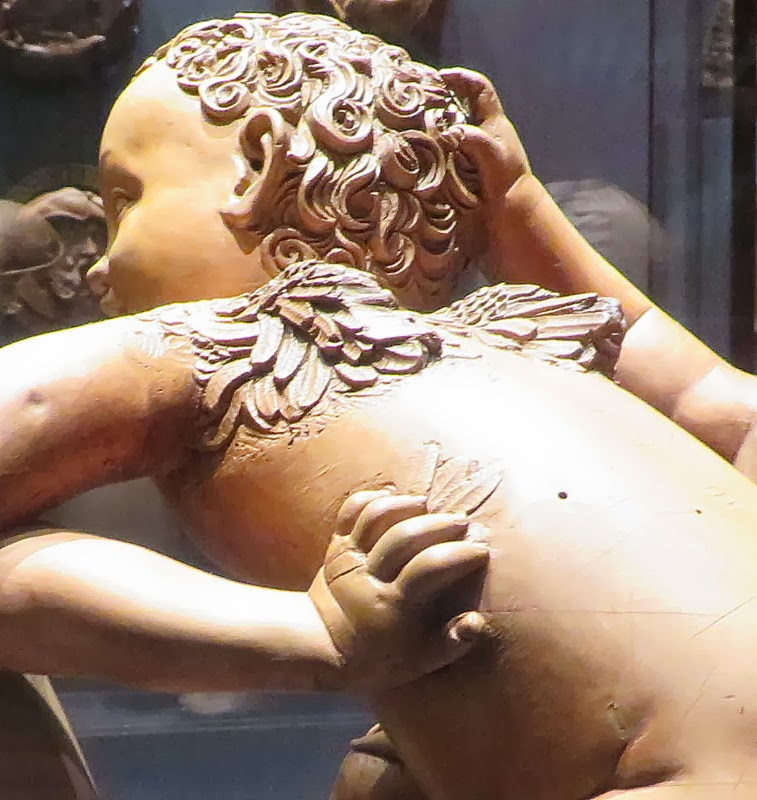
Personally, I like to close in on a piece of a painting. Learned this from my husband who likes to reduce a painting/sculpture to a smaller more intimate image and often takes photos of just the hands. 

When I saw these carved angels, I was fascinated with the wings and with the emergence of wings or are they scratches? on the back of the central angel. At home, I was able to crop my photo and examine the figure closely and admire the whimsy, the creativity, the love that poured into this work. For some reason this brought to mind the film "Black Swan" where feathers emerge from shoulders and back of the ballerina. 


Here's a piece out of a Vermeer, "The Art of Painting". I loved the whole painting but was interested in the figure and face of the "muse". In the museum, you can't get up close enough to take a really good look. With my own photo, I can look at any part of it at my leisure, without stopping museum traffic.  


I cropped out two little sections out of the famous Pieter Bruegel painting, "Children's Games". Even in the almost empty museum, there's always a little crowd in front of this one. Parents bring their children to see it. All the Bruegels are favorites. 


The faces of the children don't look as happy as the name of the painting would imply.   This painting is regularly cropped into pieces in art books as 80 games are supposed to be depicted. From Wiki, more explanation...

The children, who range in age from toddlers to adolescents, roll hoops, walk on stilts, spin hoops, ride hobby-horses, stage mock tournaments, play leap-frog and blind man's bluff, perform handstands, inflate pigs' bladders and play with dolls and other toys.They have also taken over the large building that dominates the square: it may be a town hall or some other important civic building, in this way emphasizing the moral that the adults who direct civic affairs are as children in the sight of God. This crowded scene is to some extent relieved by the landscape in the top left-hand corner; but even here children are bathing in the river and playing on its banks.
The artist's intention for this work is more serious than simply to compile an illustrated encyclopaedia of children's games, though some eighty particular games have been identified.Bruegel shows the children absorbed in their games with the seriousness displayed by adults in their apparently more important pursuits. His moral is that in the mind of God children's games possess as much significance as the activities of their parents. This idea was a familiar one in contemporary literature: in an anonymous Flemish poem published in Antwerp in 1530 by Jan van Doesborch , mankind is compared to children who are entirely absorbed in their foolish games and concerns.[2]


Everybody was fascinated by this acrylic woman - so realistic. I wanted to look closer but drew the line at crawling around the thing on my hands and knees. Many people did just that. I think it's less creepy to get the image home and wonder at the skill of the sculptor. Those feet were amazing. 


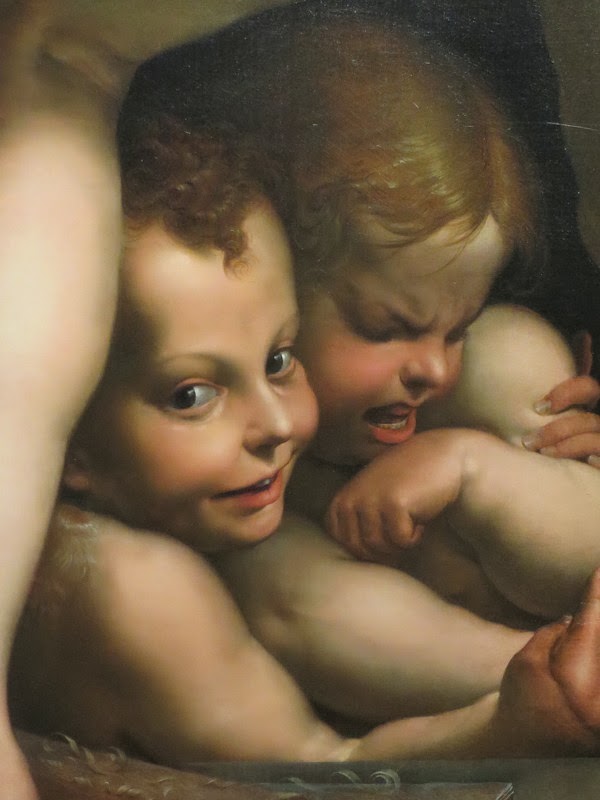
I really loved this painting, the Bogenschnitzender Cupid, by Parmigianino.  The little children under the angel pull you into the scene.  The cupid is sawing on a bow. When I cropped my bad photo (with a big reflecting light spot and too far away) I could see bits of sawdust on the shoulder of the really naughty little angel. He's holding the other child, a little girl?, so tightly her hand is red. He looks like he is pretending to protect her and embrace her but is really torturing her and getting away with it. What a look on his face. 


And to emphasize how really terrible my photo is, here's one from the Kunsthistorisches Museums
archive.


But the little cropped bit of my original isn't so bad.....
Here's one of Richard's hand extractions. I'm ashamed to say I don't remember the artist. Somebody really, really famous who would probably cringe at the idea of the painting being treated in this fashion. 


And finally, the epitome of the worst of the museum photos - the "I was there" shot.  Thousands of these horrible selfie things are taken in museums all over the world every day. We were laughing so hard when we took this that my stupid hat (scores 0 for looks, 10 for warmth) almost flew off.