Saturday, December 14, 2013

Hub and Betty


"My family is from Winnipeg." said my pretty dental hygienist in Fallbrook, blond ponytail swinging back and forth as she worked in my mouth. Her bright blue eyes twinkled through her safety goggles as she picked and scraped. "Argh,…warggle fghes thetkljshhe skeldhljl jlejfhljsi." I replied, trying to nod my head. Translation: "Hey, I'm from Winnipeg too."

And so I met the wonderful Beth who as time went by, became a very good friend. Our Winnipeg connection grew and grew as we found things in common. After her mother died she and her siblings inherited a huge and wonderful photo collection. When I saw the prompt for this week I thought immediately of her photo of Hub and Betty, her parents, at the beach.
Hub and Betty


They look so happy and worry free! Like the couple in the prompt photo, they have their camera with them on the beach blanket. The handle means it was likely a Brownie box camera. In the back ground are slides of some kind that you climb up, slide down and plop down in the wet sand or water. Were they a precursor of the water park slides? Hub and Betty liked summers, the water and the sand. It made sense that later they would pack up the family, kiss the relatives goodbye and head for Southern California. But that was after the war.


en-wikipedia

When World War 2 began, the carefree beach days were put on hold. Hub joined the Royal Canadian Air Force. He flew DC9's and Mosquitos.  Hub and Betty married on Boxing day, when he came home for Christmas break during the war.  My parents married on Boxing day too (December 26th) - something else we have in common.


deHavilland mosquito
From Wikipedia: The deHavilland Mosquito was called either the "Wooden Wonder" or the "Termite's Dream" because of its unusual plywood construction. Although it's construction did provide drawbacks in tropical climates, in the European theatre and Canada the aircraft proved to be outstandingly successful. Its wooden construction made it one of the first stealthy aircraft in an era of radar. It was probably one of the most versatile aircraft of the Second World War being used in fighter, bomber, reconnaissance, anti-shipping and even in transport roles. Bomber and reconnaissance variants carried no defensive armament relying instead on their high speed for protection.
 A total of 7,781 Mosquitos were built including 1,032 in Canada.
After they were married, Hub was stationed in Montreal and they both lived there in a quonset hut which had nothing more than drapes separating the different families.  

Beth relates, "He flew mostly transport to northern Africa.  He said they would land the plane and the men would come running out knowing he carried cigarettes and booze.   My brother recently told me that he arrived back at his base and he was totally confused about where where all the planes went and where were all the men?  It was D day and because he was away flying he never knew the plans that had been made for that famous day.  "  


Hub in his RCAF uniform

I think Beth looks a lot like her father, don't you? Except she actually has cigarettes and booze!

Beth in her book club party mode. Cigarettes and booze props only.


Friday, December 13, 2013

Close - but no cigar

Where did the expression, "Close - but no cigar" come from?
The Oxford English Dictionary states that the first such instance was from March 6, 1930 from the Cleveland Ohio Plain Dealer, where a bowling match was described:
"Peters..toppled the maples for 120, 100 and 100. Scott was right behind him with 113, 115 and 117. Close—but no cigar."
"Toppled the maples" should have become embroiled in our language too, meaning winning with a bang.

Some people take chances while visiting Cuba and smuggle cigars back into the US. If you're caught, not only are the cigars confiscated, but a fine as large as $25,000 can be imposed.  Those airport sniffer dogs are likely pretty good at locating an item with such an aggressive aroma as a cigar.  We went the safe route and brought home a scrap book full of cigar labels and a couple of cigar box labels.

Where did we find these? The tour gave us a break from our packed schedule to allow us to wander a book fair in Havana. We had 45 minutes. As we started walking among the vendors we realized there was a treasure trove of antique books on sale plus the usual stuff: lapel pins, Cuban military insignia and a ton of fake Fidel and Che memorabilia. It was overwhelming; time was very limited.  As a tchotchke acquisition strategy we had to pick out something to shop and bargain for. I homed in on a Cuban scrapbook filled with so-called vintage cigar labels.

I'm sure they're fakes; since I've been home I've been searching them on the net and you can buy replicas, bad and good, for prices all over the map. Worthless or not, they're still interesting. I've found myself engrossed in stories about the various cigar companies and I've bumped into some fascinating history about cigar bands. This is from Cigar Aficianado


However, by 1900, four of every five American men smoked cigars, and brand competition was fierce. Printing costs had been reduced, and attractive custom bands were priced at an irresistible 70 cents per thousand--2 billion bands were sold that year in the United States alone. Catalogs contained hundreds of stock choices, so generic bands could appear on dozens of different cigars at an even lower cost. Even inexpensive cigars could afford lovely, full-color bands such as those sported by Tansil's New York City knockoff of the classic Cuban Punch.
European bands were typically sold as part of a matching set including inner and outer box labels, edging, top brand, flaps and band--all marketed and sold as a package. The more individualistic U.S. cigar makers chose each element of their packages, sometimes buying labels, bands, flaps, inner paper and edging from five printers.
Bands arrived cut to shape and wrapped in thread-tied bundles of 100. Before bands were applied (almost always by women) cigars were rolled, aged, selected, packed, pressed in boxes and then removed for banding and reboxed. Traditionally bands were put on by hand, secured with a dab of plant-based glue, which the worker delicately applied with the tip of her third finger. (The operation hasn't changed much to this day.) This operation is not as simple as it sounds because bands must be put at the same height on each cigar and the glue must not ooze out, causing the band to attach itself to the cigar and risking damage to the wrapper when removed. In cigar states like New York and Pennsylvania, children were usually hired after school for the less demanding job of packaging cigars in foil, cellophane or tubes.
With 2 billion bands a year deposited in ashtrays, dropped on floors or left on cigars which were later tossed into gutters, it's no wonder that collecting bands became a turn-of-the-century mania. Cigar companies sold complete sets of colorful new bands for a dime. Albums to hold them were given away by promotion-minded tobacconists and shopkeepers.
In its drive to smash competition, the American Cigar Co. offered premiums in exchange for bands. Its huge, illustrated 1904 catalog included nearly everything a homemaker could desire. A set of children's silverware or four-collar buttons could be had for collecting a mere 50 bands. Amass an additional 179,950, and a baby grand piano would be delivered to your door. You could sleep in a four-piece bedroom set made of bird's-eye maple for a mere 44,000 bands, ride in a rubber-tired surrey for only 32,000 and kick your own football for a paltry 1,200. If the mechanical wonders of the modern age were your forte, a year's subscription to Scientific American was a scant 600. For purposes of redemption, cigar bands from American's 28 brands of cigars could be mixed with the tin tags from the company's chewing tobacco as well as paper coupons from smoking tobacco and cigarettes.
"I can remember going for walks with Mom when I was around six years old," says Carl Eike, now retired in Tucson, Arizona. "She would hang onto my hand so hard it would turn white, because every time she'd let go, I'd dive into the gutter for another cigar band off a butt." Tales like this leave little doubt as to how turn-of-the-century children earned the sobriquet "guttersnipe" as they searched for the 150 bands needed to claim a baseball glove at one of the more than 20 redemption centers located from coast to coast.
Bands that weren't turned in were often pasted on. The art of decoupage with bands reached its zenith in the first decade of this century. Magazines published tips on covering ashtrays, vases and other objects with decoratively placed bands. Truly ambitious hobbyists spent weeks carefully covering chairs, desks and even dining-room tables with arrangements of matched bands.
All this came to an end as tens of thousands of cigar companies rolled their last leaves in the 1920s and '30s. Demand and competition declined, the variety of cigar brands dropped dramatically and interest in bands began to wane.


This punch label seems to my uneducated eye to be authent


Can I import Cuban cigars into the U.S.?

No. The allowance for bringing in up to $100 worth of Cuban cigars if you were on authorized travel to Cuba is no longer in effect. All importations of Cuban cigars are illegal, including Cuban cigars that were acquired in other countries (such as Canada, England, or Mexico).
There is now an across board ban on the importation into the United States of Cuban-origin cigars and other Cuban-origin tobacco products, as well as most other products of Cuban origin. This prohibition extends to such products acquired in Cuba, irrespective of whether a traveler is licensed by Office of Foreign Assets Control (OFAC) to engage in Cuban travel related transactions.
Criminal penalties for violation of the Regulations range up to $1,000,000 in fines for corporations, $250,000 for individuals and up to 10 years in prison. Civil penalties of up to $65,000 per violation may be imposed by OFAC.
Foreign residents and visitors to the U.S.(i.e., French, Mexican etc) may not bring in goods of Cuban origin under any circumstances.

Thursday, December 12, 2013

Sepia Saturday: Bad picture, Good man


This week the Sepia Saturday challenge is to find a photo which ignores all the golden rules of photography - focus, perspective, composition. I think what makes this week's challenge even more interesting is the fact that such photos are still around!! You'd think we would toss them out, but we forget in the days before digital, film was expensive and even if the photos were bad, they may have served to trigger memories of significant events. The bad photos survived in spite of themselves. 


I found this photo dated Dec. 23rd, 1967. Bad as it is, I could never throw it away. The occasion is my cousin Maurice's ordination as a Catholic priest. Somebody had a polaroid camera and shot this scene probably from a seat in the first row. Maurice, the subject of the photo, is the face - well, the partial face between the candles on the right. The empty chair accidentally became the focal point of the picture. The upright cross bisecting the altar cross distracts the eye. The ladder-like metal work in the rear makes you look twice. What is it? The white altar cloth is indistinguishable from the white robes. Maurice may be the most least important figure in the composition. To add to the confusion, the whole thing is barely in focus; only the centrally featured chair achieves a bit of clarity. It's a bad picture of a very good man.

Maurice has led an exemplary life. At first, he chose the contemplative religious life and was a Trappist monk for many years. He served in "Our Lady of the Prairies" monastery in St. Norbert, Manitoba living in silence, poverty and prayer.

If you're interested in the monastic life, regardless of what you believe, this web site of the order is a very pleasant respite from the hustle and bustle of the holiday season. A virtual museum, it gives details of the daily rituals of the monks. There are six Cistercian abbeys left in Canada and only a few hundred nuns and monks, many of them senior citizens. Still, they manage to subsist selling hand-made specialty food products and hosting retreats. Some of the abbey communities  have been very successful in business and the subject of articles in business magazines such as  Forbes. Here's a link to one of them:
Forbes 

Looking backwards for a minute, here's Maurice and I as children nestled in my father and grandfather's legs. Who would guess one would have so much faith and the other, me, would end up with so little?

Later Maurice became a parish priest and was honored with the title of Monsignor, which in the parlance of the church means he has served in a distinguished manner and has been honored by the Pope for his service. In 2007, his parish, Our Lady of Perpetual Help, celebrated the 40th anniversary of Maurice's ordination.  This photo of him is so much better:

Because I've lived in the U.S. for decades and rarely visit Canada, I've seen little of Maurice over the years. Whenever a relative died, Maurice said the funeral service and I'd see him briefly. Pastoring a flock of his size is very demanding...even if you consider just the weddings and funerals, he has little time left over for the quiet life he once led. When we were burying my mother, he strolled around for a short while in the cemetery pointing out the many "residents" for whom he said funeral masses. Even though he has all the gravitas you'd expect from someone in his position, after a few minutes together, the years vanish and I feel towards him just as I did when we were little kids sitting on the steps in Letellier, Manitoba together.

I enjoy reading his notes (see below) in the parish paper of Our Lady of Perpetual Help, because he writes so openly and honestly. His earnestness and modesty amaze me. Because he always loved skating and hockey, it makes me smile to think he still skates with the kids at the parish school.

Merry Christmas and Happy New Year to all my Sepia friends!

For more delightfully bad photos, grab your polaroid and rush over to Sepia Saturday


"PASTOR’S VIEWPOINT 

It is important to note that the feast of the Immaculate Conception will be celebrated on Monday the 9th because the Advent Sunday has the power to displace the Virgin’s feast. This is only a liturgical displacement. Mary has been important in my life and will still keep that privileged place as Mother. When still in university I was invited to chair a group of students who met once a month to study and try to appreciate who Mary was and is for us. I really did not know much and went through the motions of chairing meetings. Then when I entered the monastic life, the name of the Abbey was/is Our Lady of the Prairies…and the influence of St. Bernard with his love for Mary made some head way into my life, but not enough. I am barely getting to know Mary and learning to appreciate her presence. I am shoveling my way through debris and snow during this Advent season to rediscover how much I am in need of renewal of honest devotion to Mary and my other friends enjoying the festivities of heavenly parties. I am writing these few lines on a beautiful snowy winter evening. The tractors are out buzzing around trying to disturb the peace and quiet I enjoy so much. No doubt that I have seen many a winter night with snow blowing and playing around my head, yet I never tire of the beauty and marvel it brings to my consciousness of the presence of God. Someone told me all snowflakes are different, one from the other. I believe it. Then I consider all the persons twirling in my life and I marvel even more at the love and tenderness of God…each one different, and I have no difficulties in realizing that…but I have to remind myself that God created them in His image and has chosen to live right there, in them, so close to me. Now, only a silent thought can fill the awareness of tender love. "

"I tend to look back at the many years of trying to become a pastor, and tend to dare look ahead and measure the length of days I should keep on skating with the grade 2 students at St. Charles school numbers are piling on and add up, one year at a time…and yes, I wonder in awe at the beauty of the passing days of life…knowing that only more beauty and more love is the destination we need to keep in sight, and to know God’s power manifested in tenderness and forgiveness so as to pass it on effectively. Lord let me see you in my experience of the snow, the people around me, the deep yearning of fulfillment expressed to me by so many of your friends. ~ Msgr. Maurice Comeault "


Wednesday, December 04, 2013

Gluten Free Guacamole

Avocados do not contain gluten. Most of the ingredients used in guacamole recipes are gluten free: garlic, salt, lemon juice, chiles, tomatoes, onions. 
Our gluten free avocado grove

Use cucumber or jicama spears for scooping the guacamole and you'll still be gluten free. Only if you use crackers or other processed food containing grain products do you have to worry about gluten. 

Check the ingredient declaration of any processed food for wheat or grain products or their derivatives. The FDA labeling regulations regarding gluten free claims, long and complicated, are worth reading and understanding if you are gluten sensitive.


Meanwhile, eat all the guacamole you want!


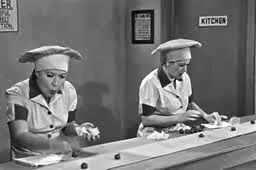
Sepia Saturday 206: Two ladies on the line


Two ladies on an assembly line? First thought: The dark haired woman resembles my grandmother. Second thought: The line is moving too slowly. The delicately extended finger on the light haired lady and the serene expression on her face leads me to think somebody needs to crank up the speed on that conveyor. 

For more information on conveyor belt speed and productivity, watch my personal standard of excellence: Lucy and Ethel wrapping chocolates in a candy factory. Click on the link for the
priceless video. 


  Lucy and Ethel

Note the lack of pinkie finger extensions. And don't you love the supervisor? 

Here's my maternal grandmother Pulcherie Fortier, who looks a little like the assembly line lady. 


Fishing was one of her favorite hobbies and she fished until she was very old. She lived to be 100 and fishing may have contributed to her longevity. 


Convey yourself over to Sepia Saturday for more stories about aprons, permanent waves and family photo treasures. 


Sunday, December 01, 2013

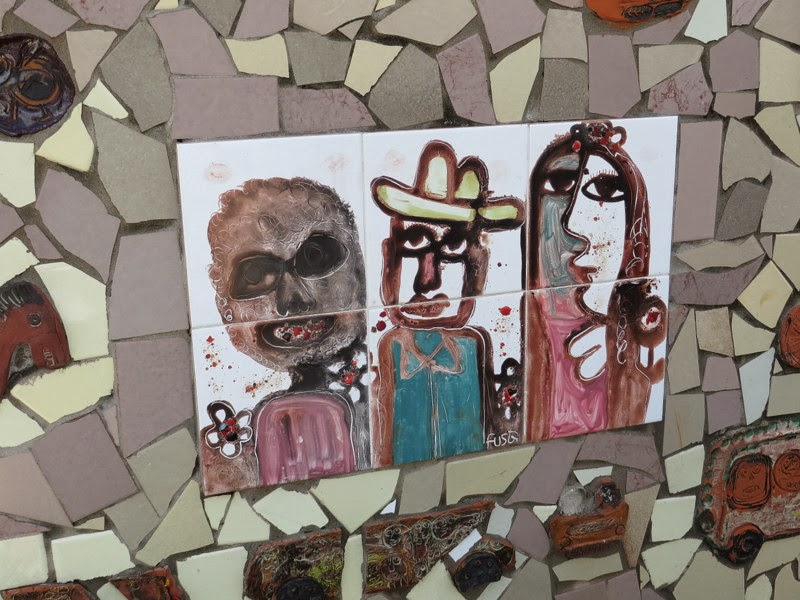
Fuser Studio


A world famous muralist, Mr. Fuser was just recovering from surgery when we visited his studio. The place is a riot of mosaic fantasies. 

Surrounded by the wild colors and shapes, I got a bit dizzy but the mild discomfort was worth experiencing the marvelous swirl of the whole place. A little like a circus ride and the Gaudi Sagrada Familia in collision with aspects of the Watt's Towers tossed in.

The Cuban art we saw in galleries was mostly abstract. I loved the bright colors and whimsy, but I couldn't live with most of it on a daily basis. I've found I like bare walls, they are less distracting and this could have something to do with my vestibular nerve and wavering horizon. The blank spaces are calming. 


My own souvenier art purchase was a portfolio of antique cuban cigar bands and a few pieces of cigar box art. I'm enjoying researching each of the cigar brands; as there are over one hundred, I could be busy with this for some time. 


Sunday, November 24, 2013

Do you smell gas?

"Do you smell gas?" asked Zuzu.
Her taxi cab companions crammed into the ancient Lada* nodded. No response from the driver.
"Do you smell gas?" asked Zuzu again....
The smell was so obvious that nobody said anything. Finally Zuzu said, "It's not for me that I'm
asking....I'm worried about you!" she said to the cab driver.

We all had our interests in the old cars in Cuba. The Lada is a left-over from the Soviet era. Much more interesting to us were the "Yank" tanks.

I under estimated how thrilled I would be to see these treasures driving around on the streets. You have to keep pinching yourself to remember that you aren't in the U.S. circa 1954. Only Cuban ingenuity keeps these beauties running; most of the engines have been replaced with diesels. Replacement parts are crafted by hand. Our guide Ernesto told us his Cuban friend, a vintage car owner, keeps the original auto engine in his living room.

Driving back to our hotel on a rainy night the speeding cab driver turned on the windshield wiper once or twice in a twenty minute ride. Only when we were completely blind.  Saving the part - that's what they do.


*From the Uncyclopedia:
"Lada is a favourite Russian means of transport. There is big tension in Russia to classify it as an Automobile, although it suits the term of "self-constructed carriage" better. In Russia it's called also as the "жигуло" ("woman's best boyfriend"). Russians buy Ladas in pre-constructed status, with about 55% of parts in their places. Final assembly should be done by buyers with an assist of big hammer and vodka.
Vodka is a kind of software called liquidware which controls the hammer. Vodka is programmed to operate the construction of a Lada; it has all the necessary blueprints programmed into it. It's created by a well known liquidware creator: "L.I.T.M.I.K.H.I.D." ("Leave It To Me I Know How It's Done") Corp. The blueprint program itself is called: "W.Y.P.O.S" ("Work You Piece Of Shit") Blueprint management system.
I was stopped for speeding in a Lada, but I was let off due to the cop laughing too much. You see, I wasn't even accelerating, someone pushed me down a very steep hill, an I managed to reach 34 mph...
Still, you don't have to think up any Lada jokes, the Lada is a joke. In Soviet Russian language, "lada" means swan - the name was chosen as the vehicle is basically an ugly duckling, but another nation had already claimed the name Turkey."

Saturday, November 23, 2013

Lucky Coin

Coins build up around here and I can't help saving them. Instead of dropping them in the Salvation Army box, I continue my life-long habit of tossing them into a piggy bank. The other day, I dumped the pigful into plastic bags and carted them to the Coin Star machine at Albertson's. The machine was noisily gobbling up the coins on schedule and suddenly I got the message to check the return slot. Much to my surprise, I removed a 1943 Canadian nickel.

It looks like a penny, sort of bronzy in color.


As I was born in 1942 and just had a birthday, it struck me as an incredible coincidence that a 70 year old coin should suddenly rattle onto my "radar screen". My best guess is that it got mixed into my piggy bank after my mother died in Canada and I brought her little change purse home.

It was in 1942, the first tombac nickel was issued in Canada. Nickel was essential to the war effort being a critical ingredient in metal alloys that would resist the incredible heat generated by new high speed jet engines. Instead, tombac, an 88% copper - 12% zinc alloy was used. Tombac got it's name from the indonesian/Javanese word for brass or copper.  In 1942, the traditional beaver design remained on the reverse but the coin was made in dodecagonal shape, with 12 sides, to help distinguish it from the cent after it tarnished in circulation.

Moving forward to my coin, in 1943 the commemorative nickel was struck incorporating a flaming torch and the V for Victory. If you don't know roman numerals you'd never know the value of the coin as V is the only designation. If you look carefully and closely you can see Morse Code under the rim which spells out the phrase, "We win when we work willingly". Somebody really liked W's! W, in Morse Code is .-- (dot dash dash). Personally, I might have gone with a V message for the rim - working in words like Valiant, Victorious, Value, Verity, although I have to admit I'm stumped when trying to think of a complete sentence composed of V words -never mind a sentence with a patriot theme. V in Morse is ...- which might not have worked so nicely around the rim. 

23,000,000 of these nickels were struck so they're hardly rare and worth between $.50 and $1.00 on Ebay.  I just thought the incident was curious. And I'm keeping the "lucky" coin. 

Cantores de Cienfuegos

"Tomorrow evening, we'll be hearing a choir here" said Ernesto, our tour guide, as we walked by a building in Cienfuegos on our city tour.  "They're quite good." he added.

As time went on, we realized that Ernesto was not one to over-sell the events on our carefully planned agenda in Cuba. We expected something like a high school or church choir, swaying to the inevitable samba/rumba beat with castanets and bongo drums -  lots of enthusiasm and probably more energy than musical expertise. The concert began at 5:00 and after a full day of sight seeing (photos below) and an hour on the bus, we were hoping it would be over quickly and we could get back to the hotel and a glass of wine.


The Cantores de Cienfuegos was a shock.  23 singers performed for our small audience of only 18. We were all blown away. At the end of the performance Richard and I agreed that it was worth coming to Cuba to see and hear just that 40 minutes of perfection. Glass of wine? Hotel? We could have sat there for hours listening to them.

The elegant choral group sings under the direction of Honey Moreira Abreu, who became their conductor originally as part of Cuba's required community service and loved it so much that she stayed on. The choir has an eclectic repertoire, singing everything from Renaissance and Baroque to Negro Spirituals and Japanese fisherman's folk music.


Honey, the director, is a beautiful, poised and articulate woman who dresses in garments with flowing dolman sleeves. When she raises them as she conducts she looks almost angelic, the sleeves billowing around her arms like wings. You feel like she's physically pulling the music out of the choir, note by note, modulating it as she desires. The choir's control of volume is so precise it's as if the director is turning a dial, like the volume control on a radio. 
www.rcm.cu
Right from the start, the performance is mesmerizing. Facing the audience, she introduces the piece they will perform and then turns to the choir. You can feel a change as she shifts into music mode. She settles her stance; they follow suit. From the folds of her garment she removes her tuning fork, strikes it against her wrist and presses the forks behind her ear. After a small nod with her head bowed for a second, she looks up and hums two or three notes to tune the choir. Her voice is clear, bell-like and even.  She raises her arms, counts a couple of beats using subtle movements of her shoulders, wrists and head and the choir starts. She conducts holding the tuning fork in her hand. It glints occasionally in the light and you can't help shifting your eyes to it once in a while. There's something magical about the small sparkles appearing and disappearing as she conducts. 

Rarely can you hear a choir with such skill. They rehearse three hours a day. Singing is their full time job and they're paid by the government to perform. Some of the performers have been singing in the choir for 20 years or more. 

I fought back tears at the beauty of the sound. It was exquisite. 


Here's a link to a youtube performance with poor sound quality. It just barely represents the superb choir but will give you an idea of their skill. 


Cantores de Cienfuegos

Since returning home, I've found that Cuba is well known for these high quality acapella choirs. Here's a clip from a madrigal group, Exaudi, world renown: 

Exaudi Cuba


Saturday, November 02, 2013

Jewelryless


This is an older Sepia Saturday that I didn't get finished in time.

I don't own much jewelry.  My wedding ring was purchased for $20 in Bali, where we were married. My earring days are long gone as I've developed some kind of allergy. Working for much of my career in laboratories and food plants, jewelry was out of the question because of the obvious:  danger from snagging yourself on equipment and having a finger ripped off; dropping bits and pieces into food being processed; harboring contaminants in the nooks and crannies. I eschewed it for myself but admired it from afar.

I remember most of my female relatives being adorned by little more than a wedding ring. My mother liked jewelry but never owned anything really valuable.

The contraption-like rigging of the jewelry in the prompt photo leads me to think this Texas belle may have had kinky masochist tendencies. The necklace connected to the belt has an S/M look; something was hurting in that arrangement. The belt looks vicious...metallic, stiff and uncomfortable. If she bent over to pick up a handkerchief, she'd be jabbed in the gut. She's probably girdled up and adding to her discomfort are those impossibly complicated earrings fluttering at the edge of her peripheral vision. If she wasn't a masochist, she'd at the least be damned uncomfortable and cranky. Using a little imagination I can see a "Get me out out of here!" look in her eyes.

Personally, as I sit here in my elastic-waisted garden pants and sneakers, the notion of wearing any kind of constrictive clothing or dangling jewelry sends waves of revulsion running down my spine. I'm eternally grateful for having been born when I was, missing some of the most uncomfortable dress eras, for instance the aforementioned girdle. Blissfully by the time I could use one, it was okay at last to jiggle a bit.  How disappointing it is (because the freedom to jiggle took a while to secure) to see the young women now choosing to squeeze themselves into Spanx Power Panties.  Is this not the girdle redux?
Spanx power panties

There's also an opportunity now for men to enjoy being squeezed for fashion in various kinds of undershirts and shorts described as "power performance" and "hard core compression" and cleverly sub-branded "Manx".  Enough of that.

It was actually the lady's bare shoulders that first interested me about the prompt. A little racy perhaps?  I was going to write about shoulders but I've already run on and on about nothing and the weeds in my garden are edging toward control. Because I did find this lovely Michael Buble rendition of my favorite shoulder song and as I'm all over the place with this post, I'm just tossing it as an ending. The tempo he chose is langorous and lovely....

 Michael Buble - Put your head on my shoulder

Friday, November 01, 2013

I wish I had crazy eyes to see you twice!

From www.cuban-traditions.com

The piropo (a compliment) is the channel to project that joyful charge of imagination in the spirit. Forty years ago it was more delicate and elegant, nowadays, although it keeps its original charm, it applies to modern resources. For instance our parents used the night (her eyes are dark as the night), to nature (if the sea were a woman, you will be its queen), to religion (God created women so that I could meet you), and even floristry (you are the favourite flower in my garden). Nowadays the piropos are different. 

They keep their charm, but they are less poetic and more realistic. You could hear:El Piropo
with those fishermen pants I would not hesitate to be fished by you; I wish I were a computer to have you navigate in my Internet. Some of them survived decades and are in used today. If you cook the way you walk, Id eat it all. In some cases the piropos can be offensive and rude, but always have a witty touch of poetry.  pick-up lines.....

"From what toy store did you escape, pretty doll?" 
"Why is doing a star flying down here?" 
"I wish I had crazy eyes to see you twice!" 
"If kissing you were a sin, I would volunteer to go to hell." 
"Don't worry if you are married. Im not jealous!" 
"With a candy like you, I would not mind to suffer from diabetes." 
"Whats going on in heaven? Angels are falling?" 

The final goal of the piropo is conquest!

Continuing on our itinerary for Cuba on Day 5, we leave Cienfuegos and bus to Havana via the Bay of Pigs, Caleton and Playa Larga. We have a Spanish lesson at the University of Havana and a tour of old Havana with a local architect. Is this instant Spanish? How much could you possibly learn in one lesson? Some of the planned events on the schedule are
laughable but will probably be fun, at the least.

For lunch we meet with a local baseball expert and then we go Jaimanitas home to ceramic artist Jose Rodriguez Fuster a muralist. After a dinner at a local restaurant we head over to La Cabana Castle and end the evening with a bang;  a cannon is ceremoniously fired into the night. Sounds kind of corny but sometimes these things are a surprise.

I'm working on some original piropos to try on my husband.
"Hey Ricardo, every time I see you I feel like making guacamole."


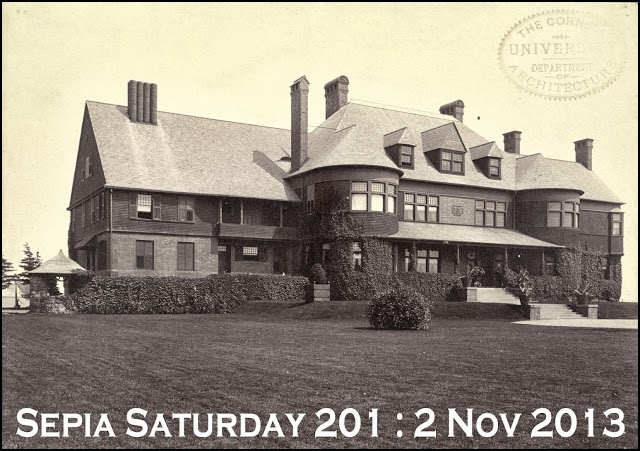
Sepia Saturday 201: Grannie was a Gambler


The splendid Robert Goelet House in Newport, Rhode Island is the prompt this week.

_________________________________________________________________________________


St. Edward's Church - raffle site
My grandmother Lucy won her home in a St. Edward's church raffle. Unfortunately I couldn't find the only photo I have of it. I loved visiting that house where she, her husband Bertie, my three maiden aunts and my bachelor uncle all lived under the same roof. After mass on Sunday, the place was full of relatives drinking tea and dunking cookies. The air was thick with chatter and every once in a while a mickey full of whiskey would be passed around to fortify the tea and fuel the conversation. Fresh from communion, we were ready to roll up our sleeves and dig into the bad behavior again as soon as possible. 

Other than Sundays when we invaded the place, the house was quiet, except for the clickety clackety sound of Grandma's rosary going round and round. It never stopped because she prayed for everybody and everything - including the horses she'd wagered money on in races all across the U.S. and Canada. She'd set the rosary aside only to commit mortal sins against the First Commandment, to wit - reading tea leaves which was considered a kind of fortune telling. She knew it was a sin and even though extremely devout, she was able to reconcile her behavior with the church law. If the priest was coming over however, tea leaf reading time was over.

mundabor.wordpress.com
When it was time to place her bets she did her phone work with one hand. The other one kept the rosary in action. The racing form, shop worn and tea stained, lay open across her lap covered with pencil marks, signs, circles, arrows and arithmetic equations of various kinds. I liked to look at the discarded forms and at a very early age had a rudimentary grasp of odds. She largely won and she won largely. There's an even longer story here, but not for now.
Not one of Grandma's forms - merely illustrative
Even though I got an early introduction to gambling and handicapping, knowledge wasn't enough for me to succeed in this branch of the family business. I didn't inherit Grandma's luck! At 17, after an initial lucky streak at the track, I lost almost all my summer earnings (around $300.00) and that was enough serious gambling for me.

I still love horse racing though and I defy you to tell me where else you can have so many thrills for a mere $2.00.
ebay.com

Fortunately I was able to find another favorite house photo.  My French Canadian farming relatives (not gamblers) moved their home from one farm to another on sled runners. The moving was done in winter when the ground was frozen and icy.


You can't see the runners on the big house but you can see them on the smaller outbuilding. 

Notice there are icicles under the eaves on the big house. I'm guessing the move was just getting underway in the photo. If the house moved one inch, I'm sure the icicles would have fallen. I also like the curtain at the window...just as if it was another ordinary day.

For something completely different, here's the trailer for the documentary film Queen of Versailles about the couple who are building the largest home, at 90,000 square feet, in Lake Butler Sound, Orlando Florida.