Guacamole Gulch

Tuesday, July 23, 2013

Sepia Saturday 187: Harvard Classics


What is precious, tattered, torn and handed down? To so many of us Sepians, the answer is photographs - family photographs passed on from generation to generation are the currency of Sepia Saturday. But occasionally other things are handed down - and in so many cases it is the family bible that becomes the linchpin of family history. So for Sepia Saturday 187  we focus our attention on family bibles. But in the best traditions of Sepia Saturday themes, you can interpret the theme in any way you want : books, lettering, printing, hand-me-downs  ... they all fall within our theme this week. Our theme image was specially created from a collage of family bible pictures provided by seasoned Sepians Kathy and Martha and stitched together by Marilyn.

We didn't have a family Bible. The most treasured books we owned were my Dad's set of Collier's Harvard Classics. My father purchased the set with his first paychecks as a lawyer, around 1923. Colliers, circa 1909, bundled together in 50 volumes everything you needed to read to become "well read".  They are not particularly rare and you can buy a set on eBay for about $300.00. To me however my set is priceless. Here's more about them from Wikipedia:


The Harvard Classics, originally known as Dr. Eliots Five Foot Shelf, is a 51 volume anthology of classic works from world literature, compiled and edited by Harvard University president Charles W. Eliot and first published in 1909. Eliot had stated in speeches that the elements of a liberal education could be obtained by spending 15 minutes a day reading from a collection of books that could fit on a five foot shelf. (Originally he had said a three foot shelf.) The publisher P. F. Collier and Son saw an opportunity and challenged Eliot to make good on this statement by selecting an appropriate collection of works, and the Harvard Classics was the result. Eliot worked for one year with William A. Neilson, a professor of English; Eliot determined the works to be included and Neilson selected the specific editions and wrote introductory notes. Each volume had 400 - 450 pages, and the included texts are so far as possible, entire works or complete segments of the worlds written legacies. The collection was widely advertised by Collier and Son, in Colliers Magazine and elsewhere, with great success. 

As you can probably tell, I never found my way to most of these classics. The volume of Grimm's fairy tales is in tatters; this one was our favorite as children. The pages are stained and dog-eared and the spine is barely holding. My mother re-covered the volume with red shelf paper. 

I wrote some really vapid notes in the poetry volumes when I was in college; my sister scribbled thoughts in the Chaucer.  Which brings to mind this wonderful Billy Collins poem. Chokes me up every time I read it. 

Marginalia

Sometimes the notes are ferocious,
skirmishes against the author
raging along the borders of every page
in tiny black script.
If I could just get my hands on you,
Kierkegaard, or Conor Cruise O'Brien,
they seem to say,
I would bolt the door and beat some logic into your head.

Other comments are more offhand, dismissive -
'Nonsense.' 'Please! ' 'HA! ! ' -
that kind of thing.
I remember once looking up from my reading,
my thumb as a bookmark,
trying to imagine what the person must look like
why wrote 'Don't be a ninny'
alongside a paragraph in The Life of Emily Dickinson.

Students are more modest
needing to leave only their splayed footprints
along the shore of the page.
One scrawls 'Metaphor' next to a stanza of Eliot's.
Another notes the presence of 'Irony'
fifty times outside the paragraphs of A Modest Proposal.

Or they are fans who cheer from the empty bleachers,
Hands cupped around their mouths.
'Absolutely,' they shout
to Duns Scotus and James Baldwin.
'Yes.' 'Bull's-eye.' 'My man! '
Check marks, asterisks, and exclamation points
rain down along the sidelines.

And if you have managed to graduate from college
without ever having written 'Man vs. Nature'
in a margin, perhaps now
is the time to take one step forward.

We have all seized the white perimeter as our own
and reached for a pen if only to show
we did not just laze in an armchair turning pages;
we pressed a thought into the wayside,
planted an impression along the verge.

Even Irish monks in their cold scriptoria
jotted along the borders of the Gospels
brief asides about the pains of copying,
a bird signing near their window,
or the sunlight that illuminated their page-
anonymous men catching a ride into the future
on a vessel more lasting than themselves.

And you have not read Joshua Reynolds,
they say, until you have read him
enwreathed with Blake's furious scribbling.

Yet the one I think of most often,
the one that dangles from me like a locket,
was written in the copy of Catcher in the Rye
I borrowed from the local library
one slow, hot summer.
I was just beginning high school then,
reading books on a davenport in my parents' living room,
and I cannot tell you
how vastly my loneliness was deepened,
how poignant and amplified the world before me seemed,
when I found on one page

A few greasy looking smears
and next to them, written in soft pencil-
by a beautiful girl, I could tell,
whom I would never meet-
'Pardon the egg salad stains, but I'm in love.' 
Billy Collins

I wish I'd spent the recommended 15 minutes a day reading the Classics.  Today, I might be able to quote something more substantial than naughty limericks and Ogden Nash. I suspect my father may have read and re-read them all; he seemed always to have a volume on his book pile. 

More personal stories about treasured books can be found at Sepia Saturday
Posted by Helen Killeen Bauch McHargue at 12:07 PM 22 comments:
Email ThisBlogThis!Share to XShare to FacebookShare to Pinterest

Friday, July 19, 2013

Sepia Saturday 186: Auntie Hilda

Brunhilde came to mind immediately. Wagnerian.

But I have nothing that matches - no swords, no armor, no lances.

What I do have is a photo of my Aunt Hilda which is as close to Brunhilde as I can get. She's second from right. Note the gentleman's arm around her waist.


 Hilda never married. Here's a letter from my cousin which offers an explanation.


The pertinent part of the letter reads: "Hilda and Stuart Carroll had a love affair for years but
they were cousins far removed that's why they didn't get married."

All my Irish Catholic aunts were named Mary something and Hilda was Mary Hilda Irene Killeen (1887 - 1968). She was one of my three "maiden" aunts and the oldest of the lot. I knew her only as an elderly woman who wore lisle stockings and those awful clunky shoes with a thick wedge heel and laces up the front..."nun's shoes".  She ended up never marrying which in those days was a tragedy; this letter implies that she never got over Stuart. Instead she worked as a secretary for the Canadian Pacific Railway for 50 years, retiring with the proverbial gold watch. I wish I knew more.

Every Sunday after mass, I would stop in at my "nest of aunts" house which was next door to the church. All three unmarried aunts lived there with my Grandmother. They lived with her for their entire lives. It was a lively home and they treated me as an adult; I loved those visits.  After the last mass on Sunday, the house would be over-flowing with cousins and aunts, chatter filling the air, lots of tea being drunk, kids running in and out of the house. My grandmother sat in a rocking chair presiding over the activities.

Here's a photo of the three maiden aunts and others with my sister in 1947. Hilda is second from right. It's a terrible picture but the only one I have of her. This was a Christmas party but looks more like a funeral. My guess is that they were just going out the door when someone said "Stop - I want to get a picture." No doubt there was fiddling around with lighting and focusing. It would have been very cold outside; December in Winnipeg often brings temperatures well below zero. The ladies were wrapped up in furs and probably very uncomfortable.  My father's white writing on the drapes adds a ironic whimsy to the glum scene. As he was probably the photographer I think he was trying to "put lipstick on a pig" as we say.


I searched for an appropriate poem or limerick to add here - something about Hilda and I stumbled on the beautiful poetry of Hilda Doolittle. Out of her vast body of work, I chose Heat for today as I sit in our avocado grove where it's 90 F.  and hear fruit dropping from the trees and thumping into the mulch. While we're waiting for the sea breeze to cut the heat, we can make more guacamole for dinner tonight.

Heat

O wind, rend open the heat,
cut apart the heat,
rend it to tatters.

Fruit cannot drop
through this thick air--
fruit cannot fall into heat
that presses up and blunts
the points of pears
and rounds the grapes.

Cut the heat--
plough through it,
turning it on either side
of your path.

Hilda Doolittle

Grab a lance and sing your way over to Sepia Saturday for more interpretations of this week's theme. 

Posted by Helen Killeen Bauch McHargue at 12:12 PM 22 comments:
Email ThisBlogThis!Share to XShare to FacebookShare to Pinterest

Friday, July 12, 2013

Beerbrella


Having nothing in my photo stash that would suffice for this week's Sepia Saturday theme, I did a Google patent search thinking I might come up with something interesting.  I found this one for a beerbrella that made me laugh. So much for the theme.

Beerbrella


 Here's the patent

Beer's been on my mind as we have a new brew pub opening up on Main Avenue. Fruit flies abounded in Beth's office (upstairs from the new pub) at this month's book club meeting; we wondered if they were attracted by the fermentation activities going on below.

Brewing has become a serious business around here; it was recently declared the second largest employer in the county. With that in mind, instead of picking up Vietnamese food to-go yesterday, I stopped at the Urge Gastropub in Ranch Bernardo and ordered a meat loaf plate and an IPA beer bratwurst. The place was moderately busy at 5 pm; thankfully and surprisingly, the music wasn't too loud.

Their beer menu is amazing long and changes every day; they offer fifty-one types of craft beer and have over one hundred beers by the bottle.  As my drinking and driving days are long since over I can only admire the libation list from afar. To that point they wisely offer several sizes presumably so you can taste a selection of brews without getting plastered. Most you can buy in half pint quantities or a "taste". The tastes run about $2.00. They have a detailed explanation of the beers and what makes them special.

One of the beers they serve is called Old Rasputin on Nitro. It's a Russian stout with 9% alcohol.We'll be in St. Petersburg for three days on a Baltic cruise in September, so I hope to drink something like this in its own terroir along with a genuine Russian pierogi. About Russian stout.....

 Inspired by brewers back in the 1800's to win over the Russian Czar, this is the king of stouts, boasting high alcohol by volumes and plenty of malt character. Low to moderate levels of carbonation with huge roasted, chocolate and burnt malt flavors. Often dry. Suggestions of dark fruit and flavors of higher alcohols are quite evident. Hop character can vary from none, to balanced to aggressive.

The meat loaf, made of veal, chorizo, Angus beef and bacon was excellent and survived the ride home very well (including a stop at Home Depot for rebar - my life is so glamorous). The crumbly texture was particularly appreciated - very unlike the tough, compact loaf that you frequently find on diner or coffee shop menus. Minced chorizo added very nice heat at a level that complimented the other ingredients without overwhelming them. The beer bratwurst was another story. Undistinguished except for an annoyingly tough casing; I had to saw through it. I did detect a whiff of beeriness about halfway through gnawing on the thing. It's quite a feat to make sauerkraut bland but they achieved it.  Disappointing. Turning my attention from the flat brat to the side order, I found the red potato salad tasteless, basically mayonnaise and red potatoes. One win for the meatloaf - it's the best! Stay away from the brat unless you have very low expectations for the wurst. Regardless of the mediocre brat, the meat loaf filled me with hope - I'd try the place again.

My other thought for the SS theme was related to cocktail umbrellas. Here's a cute alternate use for them in case you have too many on hand:


Posted by Helen Killeen Bauch McHargue at 4:47 PM 3 comments:
Email ThisBlogThis!Share to XShare to FacebookShare to Pinterest

Lunch with Larry and Lainie

I haven't seen my friends for a long tme. They were passing through the area and we were able to spend the whole afternoon at Rancho Bernardo Inn eating lunch and drinking wine. The weather was perfect..a little bit cool but it felt pretty good to the Arizonites. Don't expect a decent meal at the Inn..our Caesar salads were pretty bad; Jack in the Box quality at uptown prices. The menu is extremely limited and the service okay but not what you'd expect from the prices. The food really didn't matter; the place was quiet and our primary purpose was to catch up. We laughed remembering our happy times together, cried over a few friends now gone, caught up on our family status and collectively felt grateful that we're all still around. Lainie just turned 76 and can still turn a head.


Lainie with Thelma and Louise

Larry - probably a tail gate party


Posted by Helen Killeen Bauch McHargue at 11:07 AM No comments:
Email ThisBlogThis!Share to XShare to FacebookShare to Pinterest

Wednesday, July 10, 2013

Show Dog


My sister-in-law Paula (participates in dog Obedience shows) sent me this splendid photo she took of a Springer Spaniel getting ready for a show (conformation). His ears are wrapped to keep them in spiffy condition prior to his/her time in the ring. She recently read and recommends the book, Show Dog: The Charmed Life and Trying Times of a Near-Perfect Purebred, by Josh Dean described on Amazon.com below. The book gets great reviews.

By spending a year alongside rising star Jack, a champion Australian shepherd, and his canine and human friends, magazine journalist Josh Dean yanks back the curtain on the dog show world, providing not just a hilarious and often touching portrait of a colorful subculture only slightly exaggerated in the film Best in Show, but also a revealing look at our love affair with the world's most doted-upon and tinkered-with animal species, examining the colossal array of dog types and humans who love them. 

The book follows Jack as he matures over the course of a year, from still-improving adolescent to seasoned adult show dog. We get to know him and the people around him—his owner, his handler, his breeder—to experience what it's like to own a show dog and to train one. And we come to appreciate him for what he is, a lovable and intelligent house pet—albeit one with a highly unusual occupation.
Along the way, Dean takes a close look at the eccentric and fascinating world of breeders and dog show fanciers—exploring the history and science of purebred dog breeding and the evolution of canine perfection via dog show culture, with that pursuit's many related peculiarities: judging, training, naming, promoting, hairstyling, kennel-owning, RV-driving, hotel-finding, treat-selecting, and more. 

Here's a longer view of the springer showing that he's not just about colorful ear wrap. He's a beauty!


Posted by Helen Killeen Bauch McHargue at 1:59 PM 2 comments:
Email ThisBlogThis!Share to XShare to FacebookShare to Pinterest

Bill and Larry

Bill and Larry are getting married. Our friends announced on Facebook that they would be marrying on Sunday in Washington, DC. I thought Larry's words about marriage were lovely.


Bill said, “YES!” and I said, “YES!” . . . so yesterday we went to the DC courthouse at Judiciary Square and applied for a marriage license. The document will be ready for us on Friday.

Come Sunday morning, document in hand, we’ll meet at an undisclosed, somewhat monumental location in Washington, to be legally married.

Although our marriage won’t solve all the world’s problems, it’ll definitely help make the world a better place – and not just for us. Besides making us quite happy, our marriage will add to the stability and strength of our neighborhood, and create new family bonds.

We thank everyone we know and love for their readiness to welcome us into the refining, tempering, stabilizing discipline that marriage is. And a special thanks to the U.S. Supreme Court for helping make this wonderfully good thing possible.
 

Posted by Helen Killeen Bauch McHargue at 10:42 AM 2 comments:
Email ThisBlogThis!Share to XShare to FacebookShare to Pinterest

Thursday, July 04, 2013

Sepia Saturday 184: Serendipity

On July 6th, 1885 Louis Pasteur successfully treated a boy with rabies vaccine. The prompt  for Sepia Saturday this week is this plaque commemorating the occasion.

Pasteur discovered the principle of vaccination when he inoculated chickens with cholera bacteria. The chickens should have died; however, they did not. They were sick for a while but recovered. When he used a fresh culture of the bacteria in the repeat experiment, the chickens did not get sick. Serendipitously, he had discovered vaccination.

What is serendipity? It's often referred to as the situation when one is in search of a certain thing and in the process, something else of greater or equal value results. 

Horace Walpole, incidentally - the  inventor of the Gothic novel, coined the word "serendipity". 

From The Free Dictionary. Word History: We are indebted to the English author Horace Walpole for the word serendipity, which he coined in one of the 3,000 or more letters on which his literary reputation primarily rests. In a letter of January 28, 1754, Walpole says that "this discovery, indeed, is almost of that kind which I call Serendipity, a very expressive word." Walpole formed the word on an old name for Sri Lanka, Serendip. He explained that this name was part of the title of "a silly fairy tale, called The Three Princes of Serendip: as their highnesses traveled, they were always making discoveries, by accidents and sagacity, of things which they were not in quest of...."


So many of the products and processes we use were discovered serendipitously, the list would fill pages. I limited my list below to the everyday household items I personally take for granted every day. Serendipitous discovery I notice comes about when the discoverer is breaking a rule or indulging in some kind of moral lapse. The person is out of the groove and out of the groove is where new things happen. 
    Arthur Fry: Wikimedia Commons
    • Accident: The invention of Post-It notes is legendary.  In 1968, Dr. Spencer Silva, a scientist at 3M was attempting to develop a super-strong adhesive, but instead he accidentally created a "low-tack", reusable, pressure sensitive adhesive that has been characterized as "a solution without a problem". Arthur Fry saw an application. Eventually they became Post-It's. Even the yellow color was accidental. A lab next door to the Post-it team only had scrap yellow paper around which was initially used and the yellow color became a hallmark of the product.  
    • Rule breaking: Aspartame was discovered by James Schlatter while working in a lab trying to discover an anti-ulcer drug. He licked his fingers and tasted sweetness...incredible sweetness. His bad laboratory practice (never lick your fingers because the items you are working with might be poisonous) resulted in an amazing discovery.

    • Goofing around:  Percy LeBaron Spencer of the Raytheon Company was walking past a radar tube and he noticed that the chocolate bar in his pocket melted. Realizing that he might be on to a hot new product he playfully placed a small bowl of popcorn in front of the tube and it quickly popped all over the room.
      Early Radar range. www.kitchenretro.wordpress.com


    Van de Kamp's Saratoga Chip Shop
    •  Revenge: The first potato chip was invented by George Crum at Moon’s Lake House near Saratoga Springs, New York, on August 24, 1853. He was fed up with the constant complaints of a customer who kept sending his potatoes back to the kitchen because they were too thick and soggy. Crum decided to slice the potatoes so thin that they couldn’t be eaten with a fork. Against Crum’s expectation, the customer was ecstatic about the new chips. They became a regular item on the lodge’s menu under the name “Saratoga Chips". I worked for many years for Van de Kamp's - the company began by selling Saratoga Chips from a store front in downtown L. A.
      Wikimedia Commons

    •   Carelessness: In 1905, an entrepreneurial little 11-year-old boy with a soda-making hobby left his equipment outside in the cold all night.  When little Frank Epperson came out the next day, he found that that his stirring stick was frozen upright in his now solid soda.  He called it the “Epsicle.”  19 years later, he patented his "epsicle" “ and only renamed it  "popsicle" at the urging of his children.
      Frank Epperson: www.whenwasitinvented.org
    • Giving Up:  Lee and Perrin's Worcestershire sauce: Two chemists in Worcester, England, were approached by a customer to create a sauce he'd sampled in India. John Wheeley Lea and William Perrins' creation was so horrible tasting that they abandoned it in the basement. Two years later, the pair found the sauce had mellowed and that it flavored meats wonderfully. It went on sale in 1837.
      Wikimedia Commons
    • Laziness: Chocolate Chip Cookies: One fateful day in 1930, a little-known inn in Massachusetts ran out of baking chocolate.  Too lazy to run to the store, what was Ruth Wakefield to do except shrug and break some semi-sweet chocolate chunks into her chocolate cookie dough  instead?  After baking, she noticed that the chocolate hadn’t mixed in with the dough and found this change to be quite delicious!  This accidental innovation made her Toll House Inn a household name.
    Once these discoveries were made, they had to land in the lap of someone who recognized their worth; to take advantage of good things that appear unexpectedly and to see things changing and adapt. Serendipitous invention requires a mind wise enough to see patterns and apply knowledge to them; above all, a mind that is stimulated by mistakes and unbound by fixed thinking - willing to learn. 

    128 years later, Pasteur's famous quote still sounds good... "chance favors only the prepared mind”. And finally here's a wonderful chart of the process published with this fine paper: Maximizing Serendipity

    Read more stories inspired by the Louis Pasteur plaque here: Sepia Saturday

    References:
    The Goddess of Serendipity: www.commondreams.org
    Delicious Foods Discovered by Accident/Yummly: www.yummly.com
    Marvelous Mistakes:When food goes wrong, sometimes it's right: www.jsonline.com
    Top 10 Accidental Discoveries : www.listverse.com

    Posted by Helen Killeen Bauch McHargue at 2:43 PM 15 comments:
    Email ThisBlogThis!Share to XShare to FacebookShare to Pinterest

    Sunday, June 30, 2013

    Cranky as hell in Goa

    For Barbara:

    The lobby of the Vivante hotel in Goa is open-air and looks out at the ocean. As we settled into our chairs waiting for the check-in process to complete, the quiet was shattered by a group of 12 youngish Indian men and women bustling into the space.  The air around them crackled and I swear I caught a whiff of Bangalore/Mumbai outsourcing parfum as they glided by. Most were wearing khaki
    shorts and expensive ecological sandals - that rubbery kind (made from recycled carpeting, or cars or cell phones), with round box toes and orthotic inserts. All of them had great shiny hair and beautiful hair cuts with precise beveled edges; the kind of hair that swings around but magically returns to exactly the same place it started. Non-messable.  Slouching in our travel-rumpled clothing, sweating grey hairs curling out from under our touristic Tilley travel hats and clutching our various corny bits of travel impedimenta, we couldn't have provided more contrast. Checking their iphones every few seconds, the Indians swarmed around a seating arrangement near us, flopping into the chairs,  faces slightly blue, reflecting the light from the devices humming in their hands. Every once in a while,  we'd catch a scrap of Iconversation - a  "What?" or an "Oh shit" delivered with perfect diction in a crisp British accent and addressed to the iscreens. Nobody can say "Oh shit" like a well educated Indian! We should have known better than to select this hotel. It's inevitable in Goa that you'll bump into these up and coming Indians attending a dreadful skill improvement seminar.  The excessive enthusiasm was depressing.

    I sighed, knowing our four days of rest were ruined. We'll never escape! They'll be bouncing into the restaurant in the morning, dewy from  running down the beach,  grabbing up the yogurt and peaches from the buffet, sipping their cups of herb tea. Or they'll be lying next to that pool, displaying their discretely placed and tasteful tattoos; reading something Instructive or ieducational. Ugh!

    I stopped fanning myself with the folded map of India and for a fleeting moment considered moving onto another hotel. But then, just as quickly as they appeared, the gaggle of iIndians were buzzed back into the seminar and things didn't look quite so bad. "Maybe it'll all work out", I muttered to myself as I picked up a stack of complaint cards from the desk.


    Posted by Helen Killeen Bauch McHargue at 4:59 PM 2 comments:
    Email ThisBlogThis!Share to XShare to FacebookShare to Pinterest

    Thursday, June 27, 2013

    Sepia Saturday 183: Claustrophobia!!

    There once was a fearful spelunker
    gulping gin in his bunker, he'd hunker 
    When he finally felt brave
    He got lost in a cave  
                                                            I guess he should have got drunker.


    A cave for the prompt this week. Oh no! My heart sinks when we're traveling and I hear a cave  is coming up. In my youth, my heart would beat rapidly with excitement! And then decades ago in Roitan, Honduras I had a traumatic experience - a scuba diving accident which left me with immobilizing claustrophobia. It started immediately after the accident and was so severe, I could barely sit in my car, stand in a line or sit in an office. For three weeks I walked around in a state of near panic. I had to get treated or I guess die - do you eventually die of anxiety? Fortunately I was directed to a great psychiatrist who straightened me out in three sessions! Is that a world record? Once she walked me through my trauma, explained the post traumatic stress and the obvious link to the claustrophobia, something clicked back into place in my brain and I was able to cope with almost everything - except caves.

    Caves. At the word, my throat clamped shut, hands sweat, mouth dried, heart pounded. Caves!! The dark, dankness...the walls closing in. Trapped! Bad, bad things happen in caves and dark small places. Echoey sounds, dripping things, slippery floors, sliminess, cave-ins. Bats, bogey men, spider webs, slithery things, terror, dragons, zombies, vampires. Sweat ran down my back and I'd shudder at the very thought of having to enter one. 

    Traveling around as I have in my life it's been inevitable that a cave (or tunnel or underground something) is on every travel agenda. Most people love them, but I've had to content myself with sitting outside watching everyone's coats and bags, usually buying a guide book or post cards or a photo book of the place to get an idea of how the place looked, while waiting for my companions to emerge. Explaining about the claustrophobia was almost the worst part. Unless you've experienced it or some kind of panic attack, you'll never understand it because it's totally irrational. People think you're weak or nuts or both.

    Not surprisingly, I have no photos of caves around....the following are borrowed

    Of all the caves I sat out, Lascaux in the Dordogne, France is the one I most regret...those beautiful paintings 17000 years old. They've now had to close the caves to protect the paintings and you can only visit a cave replica.
    Lascaux    autocww2.colorado.edu

    The Postojna caves in Slovenia were another miss along with the Monastery Cave in Kiev and of course, the catacombs in Paris and Rome, the Waitomo Glowworm caves in New Zealand. The Kuchi tunnels in Saigon were a welcome miss.  The Elephant cave in Bali I could manage because it's so tiny and you're in and out in a minute. The entrance is appropriately through the mouth of a demon.
    Elephant Cave  sacred-sites.org


    Now for the happy ending. I'm not going to attempt to explain the whole thing. The short version is that we were in Vietnam a decade ago, cruising on a junk in Halong Bay, one of the most beautiful places in the world.

    nature.new7wonders.com

    I got stuck in a situation where either I went through a cave or simply got left behind - the rescue would have been mortifying. Forced into the cave, with no choice but to go forward, I did it. The rational finally trumped the irrational; the fear of crushing embarrassment trumped the terror. And guess what? The world didn't end; I didn't drop dead of a heart attack and once I saw the light at the end of the tunnel, literally, I was completely thrilled with myself.

    Caves no longer terrorize me.  I have an ever-fading memory of the cave anxiety that's etched on my brain, but it's a minor distraction. I sit no more at the entrance to caves with a little knot of fellow claustrophobics (I was never alone) but boldly march forward and enjoy the slithery sights.

    Hold your own damn coats!

    Steel yourself, stifle that phobia and head on over to Sepia Saturday for more fascinating stories. 


    Posted by Helen Killeen Bauch McHargue at 10:30 AM 35 comments:
    Email ThisBlogThis!Share to XShare to FacebookShare to Pinterest

    Wednesday, June 26, 2013

    Karaikudi -what a surprise!

    “Tourists don’t know where they’ve been, travelers don’t know where they’re going.” – Paul Theroux


    Paul is such a cynic. In much of India, I have to admit we didn't really know where we were going. We thought the Bangala hotel was only a stop on the way between spectacular temples, en route to the really big thing ahead - the Meenakshi temple complex in Madurai, one of the largest and most important in India. None of us knew a thing about the Chettiars and their extraordinary houses. Here's what our tour brief described:

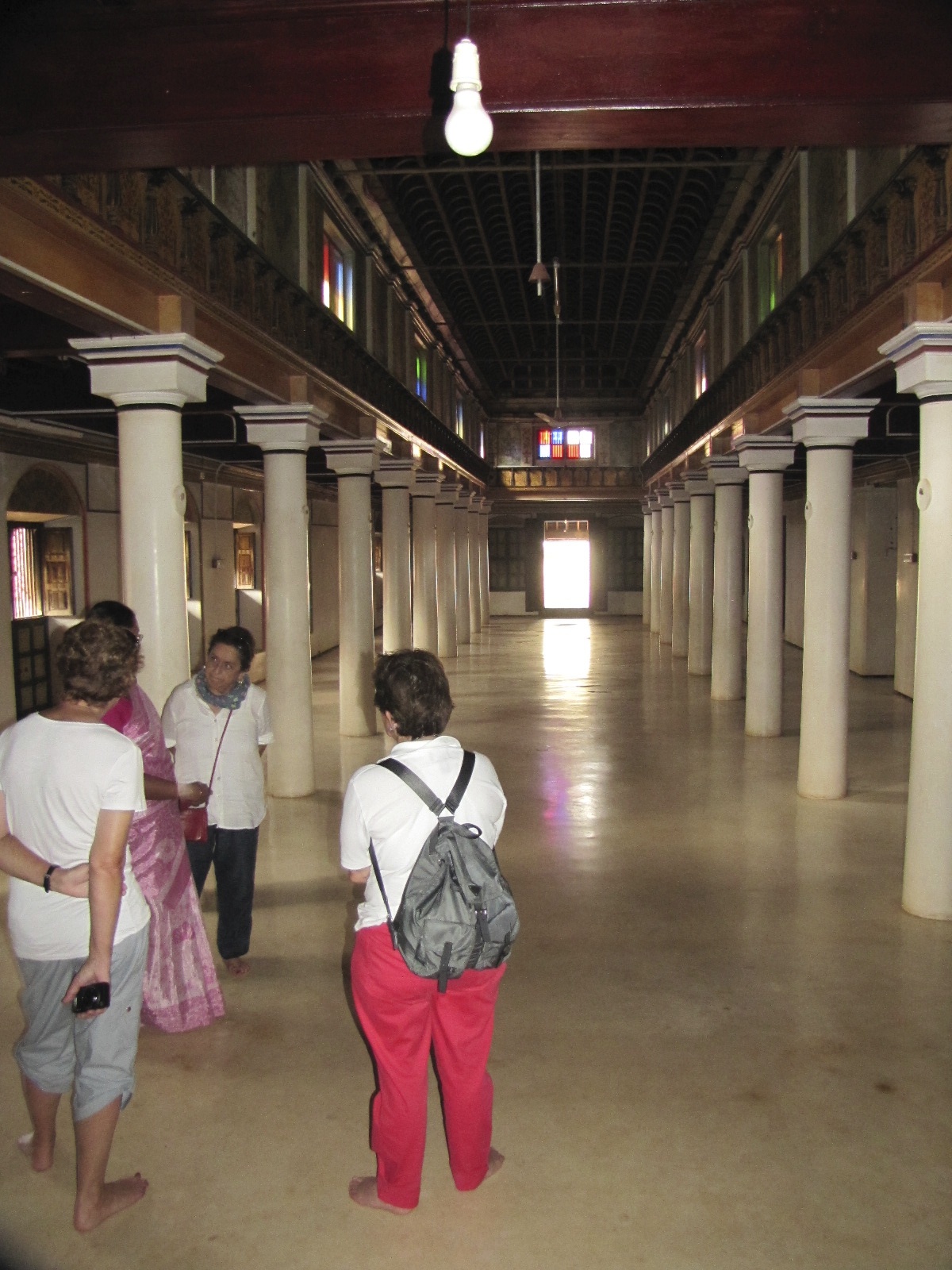
    "These houses are built on a rectangular traversal plot that stretches across two streets with the front door opening into the first street and the back into the second." Doesn't sound terribly interesting. But it was. You could spend a couple of weeks here poking around in the houses, the craft shops, the temples. We should have read more in advance.


    Madame
    First - the hotel. Large comfortable rooms, shady porches, a wonderful swimming pool. The property is a lovely restored men's club on the outskirts of Karaikudi with the best food we've had yet. Served home style and presided over by the 77 year old Chettiear "madame" of the premises; she rules the roost with an iron hand. The chef has worked for her for almost 50 years and while she doesn't cook she devises the menus. Dinner last night started with pea soup, moved to a shrimp course served with a wonderful bread and freshly grilled vegetables. Next came a breaded sea bass with another mixed vegetable dish and deep fried battered cauliflower.  Grilled quail was next and the meal finished with a spectacular strawberry panna cotta napped with creme fraiche. All courses were served by liveried men who brought the dishes round and round. One could eat each course several times if desired. Looking back, I'd say this was the best eating experience of the trip.


    The dark side: Outside the walls of the hotel, our driver Mammouj made his bed in the back of the van because the hotels either do not provide for the drivers or the drivers quarters are so dirty that he won't use them. Instead he chooses to sleep on a roll in the back of the van. He had to wash the van with bottled water - the hotel wouldn't provide it.  There's always a "behind the beautiful forevers", wherever  you go in India. There's the beautiful front and the "other" side, often more the reality in this country of great contrasts.

    Mahmooj, Debra, me - bottled water from van washing
    Now the Chettiars: The Chettiars are an old business community from Chettinad, a region of 72 villages around Karaikudi in Tamil Nadu. They began trading in salt, moved on to gems, and became financiers by the early 19th century. When the British took over Myanmar in 1826, the Chettiars settled there as moneylenders. It led them to great prosperity in South-East Asia. Much of their profit was invested in the grand houses they built in Chettinad - symbols of their power and social standing as bankers and merchants. We toured through a few of the houses. Read more detail in the article tacked on at the end of this post.


    Inside a Chettiar home


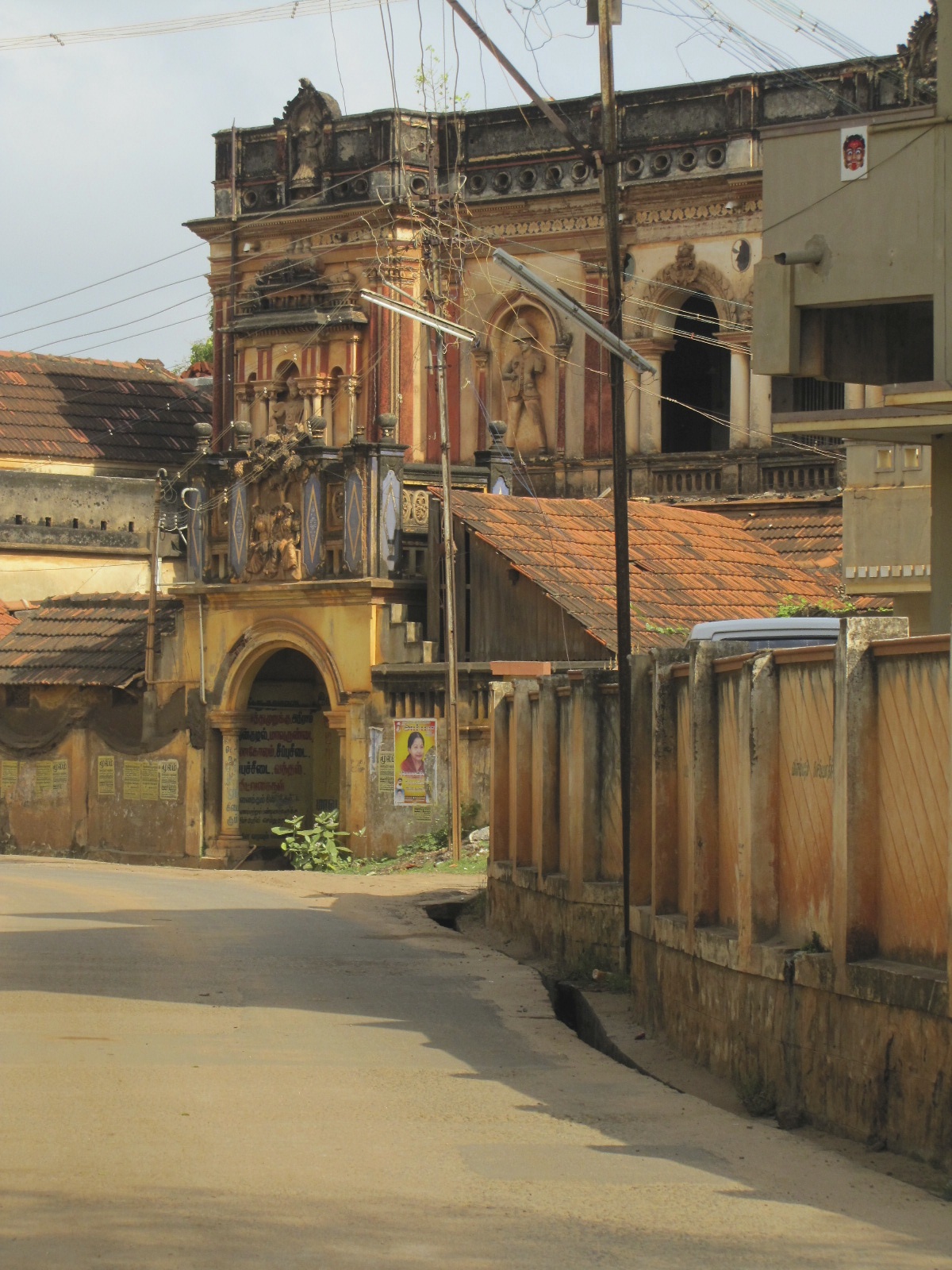
    Chettiar house


    Quiet streets


    The houses were huge. We're talking 20,000 to 40,000 square feet, filled with luxurious products and incorporating designs the Chettiars encountered during their travels. Most are eclectic combinations of the best of everything: Italian tiles, Belgian glass, rosewood carvings, Burmese teak, Victorian furniture, Spanish grill work, Gothic domes. Chettinad architecture is known for its scale, color and variety of local and imported materials. The house are built on platforms raised slightly up from the street and most have a second story. This architecture is thought to have been employed because the people originally lived on the water ; a devastating tsunami sent them inland looking for a new place to settle. Left like a scar on the unconscious was the memory of death and destruction by flooding, thus the elevations.
    Busy street
    As we traveled through quiet streets lined with crumbling buildings, it felt like we were in a ghost town. In fact that's what much of the area has become. The houses have been passed down through generations and ended up with multiple owners who often can't agree what to do with them. The properties are ridiculously expensive to keep up although the families who are still wealthy maintain them to use for family weddings, the biggest social event in India. Our guide told us that some of them are used to store dowries - I guess these dowries become enormous because you are only supposed to use them in case of emergency. The accumulated dowries have become the principal savings of many families.  The largely unused items comprising the dowries become more valuable as they age and become antiques. Many of the houses are being dismantled and the choice bits and pieces sold to architects. I looked online and saw Chettinad doors, window frames, chandeliers and tiles for sale. How sad that these items will be separated from their original locations and end up, who knows where... in a steak house in Chicago hanging on a wall? The staggering fact that I had to have repeated several times is that there are an estimated 30,000 of these palatial houses in the area. Ah India.....the surprises never end.
    Still life: bicycle and garbage


    After our house tour, we stopped at the local market and had a look at the wonderful produce grown in the area. Zouka ate three or four tomatillos, right out of the baskets, unwashed. She loves sour things, but I worried for her intestinal health. She had no problems. She has a tough Syrian gut!


    Zuzu eying tomatillos
    We passed on the modern slaughter house


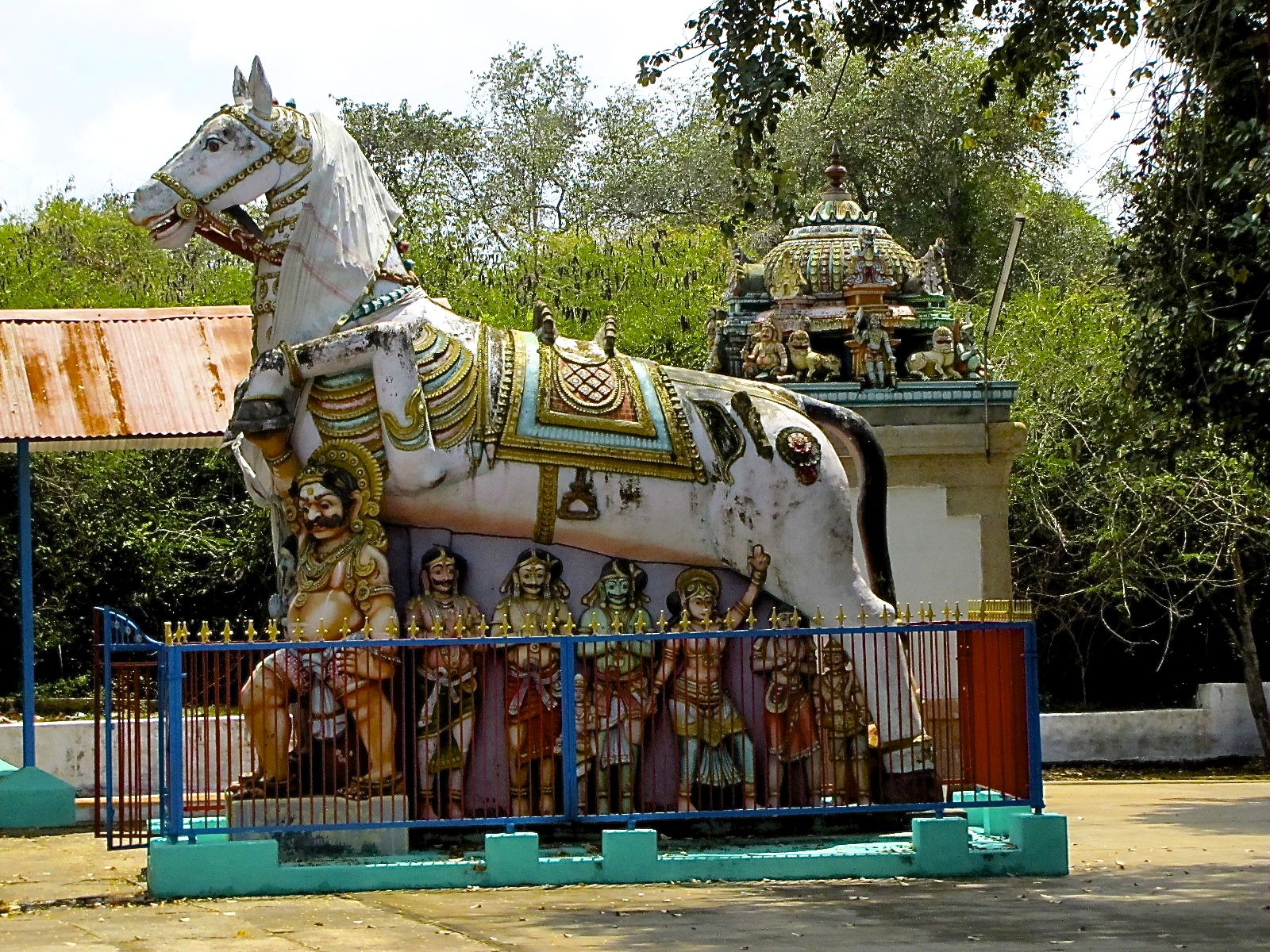
    Several kilometers from the villages of Chettinad, lies an Ayyanar temple which we visited next.  In South India, particularly Tamil Nadu, the Hindu village god Ayyanar is a popularly worshiped deity. He is known as the protector of rural villages and uniquely, the priests are usually non-Brahmins.
    The temple we visited was crowded with large whimsically painted clay horses. Our guide explained that the horses are offered in gratitude to the Gods for good crops or good luck. If you have a good year, you contract with the local potter to create one of these wonderful creatures and donate it to the temple.

    The temple was a delightful change from the huge formal complexes we've been touring. Worship takes place outside - it all seems so much simpler and more attractive than the complicated rites and ritual involved in traditional Hinduism. An architect who took us through one Hindu temple told us he had to hire a consultant priest to keep track of his religious obligations: birthdays (which change every year), anniversaries of deaths, births, weddings.

    We spotted the two ladies with the beautiful saris entering the water and asked if they'd mind having their photos taken. They were delighted. The immersion has something to do with religion, not recreation.

    Reluctantly, we tore ourselves away from the temple and returned to the Bangala for another great meal, this time a wonderful lunch of local food served on a banana leaf. The we stuffed ourselves back into the van and headed for Madurai, two hours away.

    Painting tiles in  Chettinad area. Horses at Aiyunnar temple


    Ladies bathing near Aiyuna temple

    Our charming Chettinad guide and me


     Up close clay horse of Aiyanar Temple Chettinad Tamil Nadu India
    Lunch at the Bangala


    Geographical Magazine: Putting the houses in order

    During the Raj, the Chettiars of Tamil Nadu built thousands of palatial homes, but after the end of the colonial era, the houses fell into disrepair. Now, many are being restored to their former glory, writes Luke Duggleby
    Money was no object; only the best would do. Tiles were brought in from Spain and Japan in their millions, thousands of tonnes of teak arrived from Burma, and marble and extravagant crystal chandeliers came from Italy. Mirrors were imported from Belgium, the steel came from the UK, and the whole lot was combined with millions of hand-baked roof tiles and paint made of hundreds of thousands of eggshells.

    But the palatial abodes built from these international ingredients weren’t one-offs, the odd individual looking down on his less-fortunate neighbours; there were tens of thousands of them, scattered across an area of 1,500 or so square kilometres.

    These are the mansions of Chettinad, an arid land of bush and scrub located in the heart of Tamil Nadu in southern India. Very little grows here; summer temperatures frequently exceed 40°C and the baked earth holds few resources of any value. But none of that mattered to the Chettiars; this parched back­water was a safe place for them to live, free from interference and in the lap of a self-created luxury.

    Distant origins
    The Nattukottai or Nagarathur Chettiars are a sub-caste of the Vaishya, the third-highest of the Hindu social classes. Their early history is sketchy at best, with no firm historical evidence to explain their origins. One legend suggests that a tsunami destroyed their coastal town and, fearing a repeat, they fled inland to the driest place they could find.

    Following their arrival in this desolate part of Tamil Nadu, they made a modest living doing business locally, specialising in trade and banking. It was with the arrival of the British during the 18th century that their fortunes changed. British expansionism was rapidly engulfing South and Southeast Asia, country by country, and when the East India Company set up shop in Madras (now Chennai), the capital of Tamil Nadu, it brought the British and the Chettiars together. The British needed reliable and honest middlemen through whom they could deal with the locals, and the rajahs of southern India recommended the Chettiars, who had a reputation for reliability and honour.

    Early business dealings primarily involved local transactions of modest sums, but in 1774, the headquarters of the East India Company was moved to Calcutta as the company looked to expand into Burma. The British ruled Burma from the 1820s to the 1950s, and the Chettiars were never far behind, doing business on an enormous scale. ‘The Chettiars understood the political and geographical context of this period and took full advantage,’ explains Michel Adment, a French architect who, along with his partner, Bernard Dragon, has lived in Chettinad since 2004. ‘The British essentially opened up these countries one by one, giving the Chettiars access.’

    But despite trading in exotic and foreign materials in distant lands, the Chettiars always based their operations in Chettinad. ‘The Chettiars were very worldly, but their society was held together by very strict rules, such as marrying within the caste and land ownership,’ Dragon says.

    At the height of the Chettiar’s success, they numbered more than 110,000, living in 96 villages and towns scattered across the region. They used the wealth they accumulated to build enormous, ornate mansions; the total number is difficult to ascertain, but is believed to have been as high as 60,000.

    When Adment and Dragon arrived in Chettinad in 2004, the population was relatively unchanged, but the number of Chettiar villages had decreased to 73 (as well as two cities) and the number of mansions had dropped to about 25,000. ‘Houses are currently being demolished at a rate of 20 per month, and many more are ready to come down,’ says Meenakshi ‘Madame’ Meyyappan, a hotelier based in Karaikudi – the largest city in Sivaganga district and the unofficial capital of Chettinad – and the wife of a wealthy Chettiar who worked mostly in Malaysia. Others dispute these numbers, but Meyyappan is adamant: ‘How do you get all these warehouses full of our antiques if our heritage is not disappearing?’

    Starting over
    So what went wrong? While the Chettiars had made fortunes making Burma the rice bowl of Asia and developing coconut and rubber plantations throughout Southeast Asia, they also acted as local moneylenders. But during the first half of the 20th century, the development of nationalistic movements in Southeast Asian countries, the growth of legislation restricting indigenous banking and the increase of industrial opportunities within India for non-British businessmen all began to eat away at the Chettiars’ business empire.

    But if there was a single action that could be held responsible for the ultimate crash, it was the British withdrawal from Burma. Almost 70 per cent of Chettiar wealth was concentrated there, and in the eyes of the new regime, the Chettiars were the accomplices of an unwanted ruler. They were forced to flee, leaving behind everything for which they had worked. Vast tracts of paddy field and business interests were abandoned as the Chettiars returned to Chettinad with nothing but the houses their fortunes had built.

    Few Chettiars had bothered to invest in India, distrusting the country and disgusted by the endemic corruption, yet they now found themselves back there, unable to compete in areas where other businessmen had grown strong in their absence. The Chettiars essentially had to start from scratch. ‘No-one was able to continue because they had no money to lend, so they began educating their children, and are now becoming successful again,’ says Meyyappan.

    But where did the money come from to educate this new generation? The mansions. One by one, they began to be dismantled and sold in the vast furniture and antique markets of Karaikudi and Chennai. With some properties containing more than 1,800 tonnes of teak alone, there was plenty of money to be made by selling the homes and their contents to India’s newly rich.

    By 2006, more than half of the mansions had already been torn down. Dismayed by the rapid disappearance of this forgotten corner of India’s architectural heritage, Adment and Dragon contacted Dr Minja Yang, director of UNESCO’s New Delhi office. ‘I was aware of the Tamil traditional house layout of the succession of courtyards, but I did not know about Chettinad,’ Yang explains. ‘I must say, I was impressed when I first saw the town-planning ambition of these Chettinad villages – their wide streets, the buildings aligned in an orderly manner.

    ‘Looking at the facades of “hybrid” style, that funny mix of Europe and Asia, it made me think of the “native” colonial style of some buildings in Vietnam,’ she continues. ‘When I walked into the Chettinad houses, I was blown over by the harmony and the tranquil beauty, despite the rather busy decorative features in some of the houses.’

    Yang immediately set to work, attempting to convince the national, state and local authorities to protect, conserve and enhance the villages and towns of Chettinad. ‘We decided to “adopt” Chettinad as one of the UNESCO cultural itinerary routes in India, and started to multiply our contacts and official meetings with the cultural and tourism authorities of the Tamil Nadu state government,’ she says.

    Rescue mission
    In 2006, the newly formed Revive Chettinad Development Project successfully petitioned UNESCO to place Chettinad on its watch list for the World Monument Fund. As the project gained momentum, it began to receive backing from the French government, as well as the state government of Tamil Nadu and the Indian Ministry of Culture and Tourism.

    Once funding had been secured, the next hurdle was figuring out exactly how to save the mansions. ‘There was no real conservation plan in an urban context in India. Chettinad was really the pilot project,’ Dragon explains.

    Because of the region’s remoteness, and lack of any local written records, no-one knew how many mansions there had been to begin with, nor how many were left. There weren’t even any maps. So the first step was to carry out a detailed survey of the whole of Chettinad, a group of architects and urban planners, as well as a French geographer working for six months to document what was left.

    The next step was to start work on saving the mansions themselves. Here they faced another set of obstacles. First, there was the Chettiars themselves. Many still lived abroad or in one of India’s major cities. Many also had little interest in their old family palaces, having left them in the hands of housekeepers and butlers, who dealt with the day-to-day upkeep but had no power when it came to decisions about the property.

    Then there was the issue of multiple ownership. As these were family homes, ownership was split between the male heirs, and any decisions about sales or restorations could only be made with the agreement of all of those heirs.

    Some outsiders were lucky. When the Indian hotel group CGH Earth, which specialises in heritage properties in southern India, decided to rent and restore one of the properties in the village of Kanadukathan, it discovered that it only had one owner, who readily agreed. Between 2005 and 2007, the company carried out a meticulous restoration of the 80-year-old art-deco-styled building using traditional techniques. Thus was born the Visalam Hotel, the first hotel opened by non-Chettiars in the region.

    ‘When we opened, all the Chettiars came to see,’ says Johny Peter, the hotel’s general manager. ‘They didn’t stay or come to eat, but just to have a look. Now they all call CGH Earth and ask if we want to lease their mansion.’

    Peter acknowledges that the mansions are in a dangerous position, but sees the Chettiars themselves as the ultimate hurdle. ‘Their attitudes have to change, and the Visalam leads through example,’ he says.

    Great potential
    Tourism is vital in bringing much-needed capital into the region. The Visalam may lead, but others are now following. ‘The Chettinad region has a great potential for heritage-based development because of the diversity of its tangible and intangible heritage,’ Dragon explains. ‘Sustainable tourism should be an opportunity for the development of the region, but local authorities have to make the region ready for such a development by improving infrastructure, implementing conservation and protection plans at regional and village levels, and helping the inhabitants by giving grants for the restoration of their homes.’

    Yang is more blunt. ‘It seems absolutely crazy to allow the incredible built heritage of these towns and villages to decay,’ she says. ‘It’s like allowing oil to spill into the open sea without capping it and making use of it.’

    But saving a mansion is a lot more work and far more expensive than destroying or even maintaining one. And with people regularly knocking on their doors offering to buy the valuable resources inside, there is a constant temptation for the Chettiars to simply take the money and run. So the question now is, will they take as much pride in saving their heritage as their ancestors did in building it?

    October 2011


    Posted by Helen Killeen Bauch McHargue at 1:49 PM 2 comments:
    Email ThisBlogThis!Share to XShare to FacebookShare to Pinterest
    Newer Posts Older Posts Home
    Subscribe to: Posts (Atom)

    Printfriendly

    Search This Blog

    About Me

    My photo
    Helen Killeen Bauch McHargue
    I'm a retired food professional living on an avocado grove in Fallbrook, California with my husband and cats. Through my consulting business, Food Smarts, I've worked for restaurant chains, food manufacturers and commodity boards. I've always liked to write (who doesn't) and enjoy scribbling now and then.
    View my complete profile

    Feedjit

    • Spitalfields Life
      The Lost World Of The Alleys
      1 hour ago
    • The New Yorker
      Sam Smith on Their New Album, “Hazel Eyes”
      6 hours ago
    • News From Nowhere
      Escaping The Mill
      1 day ago
    • Blue Heron Blast
      Lost week
      3 days ago
    • David Lebovitz
      Video: making chocolate-olive oil spread With Deb perlman of smitten kitchen
      1 week ago
    • Serious Eats
      We Tested 10 Tofu Presses—Three Squeezed Out the Competition
      3 years ago
    • Vivian Swift
      On Taking a Joke.
      4 years ago
    • The Kitchen Sisters
      Better Now Than Never: Safeguarding Your Audio Collection
      4 years ago
    • JaneVille
      Register now for Creative JumpStart 2022!
      4 years ago
    • Bric-a-Brac, Robert and Morrison's blog
      Workshop and Artist talk
      7 years ago
    • Stay at Stove Dad
      Announcing My New Book--Order Now and Get a Free Print!
      7 years ago
    • Janet Deneefe
      Bakso and the Fasting Month!
      8 years ago
    • The Girl Who Ate Everything
      The giant manatee-shaped doughnut that got away, and the friend who ate it for me
      8 years ago
    • Scheherazade's Journal
      The Promise: the Armenian Genocide
      9 years ago
    • Banar Designs
      Paris
      10 years ago
    • cimilar cinema
      Drug Lords in Film
      11 years ago
    • Ladies of the Grove
      My Favorite Dog Photos
      11 years ago
    • fxcuisine
    • Banar Designs
    • Food Smarts

    Blog Archive

    • ▼  2025 (1)
      • ▼  November (1)
        • I haven't posted for a few years. Foolishly, I qui...
    • ►  2021 (12)
      • ►  July (1)
      • ►  June (1)
      • ►  May (10)
    • ►  2020 (3)
      • ►  February (1)
      • ►  January (2)
    • ►  2019 (6)
      • ►  September (4)
      • ►  April (2)
    • ►  2018 (51)
      • ►  December (1)
      • ►  November (1)
      • ►  September (8)
      • ►  August (3)
      • ►  July (4)
      • ►  June (2)
      • ►  May (5)
      • ►  April (2)
      • ►  March (4)
      • ►  February (5)
      • ►  January (16)
    • ►  2017 (105)
      • ►  December (8)
      • ►  November (15)
      • ►  October (6)
      • ►  September (5)
      • ►  July (3)
      • ►  June (3)
      • ►  May (7)
      • ►  April (24)
      • ►  March (15)
      • ►  January (19)
    • ►  2016 (182)
      • ►  December (23)
      • ►  November (5)
      • ►  October (20)
      • ►  September (19)
      • ►  August (16)
      • ►  July (7)
      • ►  June (9)
      • ►  May (10)
      • ►  April (30)
      • ►  March (19)
      • ►  February (13)
      • ►  January (11)
    • ►  2015 (201)
      • ►  December (19)
      • ►  November (11)
      • ►  October (15)
      • ►  September (8)
      • ►  August (8)
      • ►  July (12)
      • ►  June (28)
      • ►  May (14)
      • ►  April (13)
      • ►  March (21)
      • ►  February (23)
      • ►  January (29)
    • ►  2014 (153)
      • ►  December (28)
      • ►  November (1)
      • ►  October (18)
      • ►  September (26)
      • ►  August (11)
      • ►  July (13)
      • ►  June (8)
      • ►  May (8)
      • ►  April (19)
      • ►  March (4)
      • ►  February (2)
      • ►  January (15)
    • ►  2013 (105)
      • ►  December (19)
      • ►  November (6)
      • ►  October (13)
      • ►  September (8)
      • ►  August (5)
      • ►  July (7)
      • ►  June (5)
      • ►  May (12)
      • ►  April (3)
      • ►  March (11)
      • ►  February (6)
      • ►  January (10)
    • ►  2012 (123)
      • ►  December (12)
      • ►  November (6)
      • ►  October (8)
      • ►  September (4)
      • ►  August (4)
      • ►  July (10)
      • ►  June (2)
      • ►  May (6)
      • ►  April (10)
      • ►  March (12)
      • ►  February (26)
      • ►  January (23)
    • ►  2011 (119)
      • ►  December (9)
      • ►  November (6)
      • ►  October (2)
      • ►  September (3)
      • ►  August (10)
      • ►  July (14)
      • ►  June (11)
      • ►  May (6)
      • ►  April (19)
      • ►  March (16)
      • ►  February (10)
      • ►  January (13)
    • ►  2010 (171)
      • ►  December (12)
      • ►  November (9)
      • ►  October (3)
      • ►  September (10)
      • ►  August (12)
      • ►  July (15)
      • ►  June (21)
      • ►  May (4)
      • ►  April (20)
      • ►  March (24)
      • ►  February (20)
      • ►  January (21)
    • ►  2009 (119)
      • ►  December (25)
      • ►  November (13)
      • ►  October (16)
      • ►  September (12)
      • ►  August (18)
      • ►  July (15)
      • ►  June (10)
      • ►  May (3)
      • ►  April (2)
      • ►  March (2)
      • ►  February (1)
      • ►  January (2)
    • ►  2008 (61)
      • ►  November (3)
      • ►  September (10)
      • ►  August (8)
      • ►  July (11)
      • ►  June (9)
      • ►  May (9)
      • ►  April (1)
      • ►  March (1)
      • ►  February (1)
      • ►  January (8)
    • ►  2007 (51)
      • ►  December (10)
      • ►  November (1)
      • ►  October (5)
      • ►  September (2)
      • ►  August (9)
      • ►  July (20)
      • ►  June (1)
      • ►  May (2)
      • ►  April (1)
    • ►  2006 (1)
      • ►  November (1)

    Total Pageviews

    free counters
    Free counters

    Popular Posts

    Contact Form

    Name

    Email *

    Message *

    Everything written on this blog originates with me or someone else from whom I've received permission or to whom I ascribe ownership or for which I claim fair use. Anything of mine can be copied and used without my permission; I'd consider it a compliment unless money changes hands and then we'll see. Nobody will ever burn in hell for copying anything from my site; danger lies only in suffering indigestion from incorrectly reading the recipes. If you stay alert, you'll be OK. Have a nice day.

    LinkWithin

    Related Posts with Thumbnails

    Avocados

    Avocados
    There's one in every crowd.
    Simple theme. Powered by Blogger.