I bought a new camera to take on our upcoming trip: Sony Cybershot DSC-HX400V with a 50x telephoto and 20.4 megapixels. Standing in the same spot, I took these four photos, using the telephoto extended about as far as it will go. The final one, with the lens extended completely, is grainy. I have no illusions about myself as a photographer and don't hope for more than one good shot out a trip - this camera should help. I'm having fun learning the cameras features and so far I'm enjoying it. The batteries run out in a hurry. I guess from all the zooming in and out.
1. Note the stem sticking out close to dead center.
2. Zoomed in.
3. Closer.
4. Closest
Unzoomed
Closer
Closest.
I took this photo from the deck this morning. The fog was swirling around and the three oaks in the distance would be visible one minute and then smothered in fog the next. The nice thing about taking photos is the fact that you pay attention to things around you that you usually take for granted.
Presenting Adrianna, the littlest acoustic neuroma patient ever. She's five years old and her translab surgery was about 6 weeks ago at USC Keck medical center with the celebrated Dr. Rick Friedman.
Dr. Friedman and Adrianna before her surgery
Her recovery has been nothing short of remarkable. Her mother tells us she experienced no pain. As you can see, she has temporary paralysis on the surgery side resulting from the trauma to the facial nerve which occurs when the tumor is scraped away. She's recovering movement quickly. Shortly after the surgery she celebrated her 6th birthday and she is back at school now. It will likely be a year until her face is back to normal. Meanwhile, I read that her mother is helping her to be humorous about her "funny" face with the kids at school.
Other AN people from all over the world sent her gifts and cards - there's been an outpouring of love and affection for her.
Here's her tumor - the big whitish ball on the lower half of the MRI slightly to the right. It was discovered as part of a wellness test she was given prior to starting school. Hearing is tested routinely as part of these tests and she turned out to be deaf in her right ear. Further investigation, including the MRI, revealed a very large tumor. She might have died if it hadn't been discovered, but now her prognosis is excellent.
We're leaving soon for a rather long and exciting piece of travel. We start out in Amsterdam in an apartment in the Museumplatz. We have tickets for the Concertgebouw for two performances and the remainder of our time we'll spend in the Rijksmuseum. On to Lisbon for only one night, where we will catch a Fado performance. Next we board a cruise ship and sail for 25 days from Lisbon to Capetown stopping at Tenerife, Cape Verde, Dakar, Banjul, Ivory Coast, Ghana, Togo, Sao Tome, Angola, and Nambia to name a few of the ports. After a few days in Capetown, we move on to Botswana, where we'll be in two different safari camps. Our last stop is Johannesburg, where we'll be visiting Lesotho...thus the photo at the beginning of the post! It was a long and wordy trip along the west coast of Africa to get to my point. The planning has been extensive and time-consuming, but I'm sure it will all be worth it.
There's a large clothing manufacturing industry in Lesotho. 40,000 people, mostly women, work in factories owned by Chinese and Taiwanese manufacturers sewing clothing ultimately sold under the Gap, WalMart and Levi Strauss brands, to name a few. I've attached an interesting article on the industry below...it's from www.equaltime.org.
Even though I resist buying tourist geegaws when we travel - there are boxes of them in our attic which will end up in a thrift store (if they're lucky they'll recycle but most likely their destiny is the garbage heap), I know I'll be tempted by the weavings I've seen which come from Lesotho. Here's some examples from Setsoto Design. I wonder what "sate closed for the rabbits" means?
Setsoto Design
Setsoto Design
Setsoto Design
IN DEPTH
IS LESOTHO’S GARMENT INDUSTRY AN ‘ETHICAL ALTERNATIVE’?
With just over two million inhabitants, the southern African kingdom of Lesotho is one of the world’s smallest countries.
Lesotho’s 40,000 garment workers are mostly women. As a result, maternity leave is a major issue affecting workers.
(World Bank Photo Collection/John Hogg)
A low-income country that currently ranks 160 out of 187 on the UN’s Human Development Index, workers earn an average salary of US$570 per annum and some 42 per cent of its citizens are jobless.
However, over the last eight years, its textile and garments manufacturing industry has grown to become one of Africa’s biggest.
At its peak in 2008, Lesotho’s garment and textile exports totalled US$340 million.
The introduction of the African Growth and Opportunities Act (AGOA) by the United States government in 2000 provided Lesotho (and other participating countries) with preferential access to the US market.
Fifteen years later and Lesotho’s garment industry contributes 20 per cent to the country’s GDP.
In addition, 80 per cent of Lesotho’s garments are manufactured for US mega-brands such as Gap, Levi Strauss and Wal-Mart.
As a result, the growth of Lesotho’s textile industry has brought various benefits to workers on the factory floor.
Thirty-four-year-old Teboho Moeti is tasked with pressing steam irons over rows of casual denim shirts at Formosa Denim Mill in Maseru.
For Teboho, who comes from a small village 200 miles away, his job is ‘precious’.
“I didn’t go to school much but I earn US$420 every month ironing new shirts,” he tells Equal Times.
Teboho’s salary, which includes bonuses and other benefits, is well above the sectoral minimum wage of US$92 a month, and demonstrates that in many ways, the conditions in Lesotho’s textiles industry are more favourable than those endured by garment workers in Asia.
In factories from Cambodia to Bangladesh, garment workers face low wages, dangerous working conditions, few labour rights and, in extreme cases, forced labour and child labour.
In Lesotho, 40,000 mainly female workers are employed in 40-odd modern factories, and are protected by a raft of labour laws.
“Anyone under the age of 18 years is banned from working in the garment factories. They are not even allowed to scrub decks,” says Pilani Beletho, a factory inspector in Lesotho.
Lesotho also has one of the world’s highest HIV infection rates (23.1 per cent of the adult population is HIV-positive), which has taken its toll on garment workers. But a number of initiatives, such as the Apparel Lesotho Alliance to Fight AIDS, work on the prevention and holistic treatment of workers living with HIV/Aids.
Maternity leave
But unions point to a number of other issues regarding the country’s largest private sector employer.
While Lesotho labour law makes provisions for holiday leave, sick pay, pensions and injury compensation, these rights are not always guaranteed.
Thabo Tshabalala, a regional officer at IndustriAll-Africa points to the issue of maternity leave, which is a major concern given the industry’s young, mainly female workforce.
“Pregnant workers frequently lose their jobs,” he says.
Many garment workers have to stand for their entire nine-hour shift doing physically demanding work, and this often continues even when workers become pregnant.
And while recent labour law changes now allow pregnant workers to take six weeks maternity leave, many people are unaware of these amendments and only take two weeks.
Then there is the issue of wages.
“Yes, we have a starting [sectoral] wage but US$92 is a shame. It is a poverty wage,” says Tshabalala.
“Workers in China earn more than [they do in] Lesotho.”
And while freedom of association is respected in theory, there are often serious obstacles with regards to union membership.
Pepe [he refused to give his real name in case of reprisals] was representing a worker whose fingers were burnt by an industrial clothes press.
“I was bluntly told [by my employers] to choose between my job and the trade union,” he told Equal Times.
This kind of intimidation goes some way to explain why only 58 per cent of Basotho textiles workers are represented by unions, according to the Lesotho Amalgamated Clothing and Textiles Workers Union.
Health and safety is also still a big issue in Lesotho’s garment factories.
The country’s high altitude means that it can be very cold and workers frequently complain of not being warm enough on the factory floor.
“We need jackets and wool fleeces in winter,” says Mzi Dakatho, a yarn cotton spinner.
“But if we complain too much sometimes supervisors call us ‘devils’.”
Labour inspectors have also recorded other major health and safety infractions: poor ventilation; not enough fire exits; the unsafe storage and use of chemicals and clothes dyes; and the under-supply of face masks (required to protect workers from dust, fumes and fibres).
Better Work Lesotho
Since 2010, Better Work Lesotho, an initiative of the International Labour Organization (ILO) and the International Finance Corporation (IFC), has been working to improve conditions for factory workers by monitoring adherence to core ILO labour standards and national labour laws, and improving the relationship between workers and factory management.
To date, Better Work Lesotho has negotiated employee health and sanitation inspections with 22 garment factories in the country.
Alex Jo Seng, from Taiwan, owns the Manuk Garment Embroidery Factory. He admits: “I didn’t know the importance of fire drills and steam boiler inspections until Better Work Lesotho visited. I have up to 300 workers. I want to expand safety provisions for my labourers. Even my technicians from Taiwan must be trained on ethics and employee safety.”
But while factory owners accept the importance of adhering to safety standards in principle, they are very clear about their priorities.
“Profits are uppermost in our minds. Nothing else,” says Zing Tor Weibo a factory exports manager from China.
And with AGOA expiring later this year, these profits could be in serious jeopardy. Experts are worried that Lesotho will find it difficult to compete on the global market without the act, and like other AGOA beneficiaries, Lesotho is actively lobbying the US to extend the agreement by another 15 years.
But AGOA is not a magic pill. Concerns have also been expressed that the trade generated by AGOA has been more beneficial to foreigners than it has been to locals.
All of the Lesotho’s garment factories are owned by Chinese or Taiwanese migrants, leaving commentators to wonder how much genuine economic transformation these investments really bring to the country.
“It’s a fragile success,” says Tshabalala.
“If there is an economic downturn in Lesotho like what we saw in Greece, these factory owners could easily withdraw their money and jump ship back to their home countries.”
But ultimately, the economic boost delivered by AGOA to Lesotho’s economy has been crucial, he says. Without it, the garment industry in this small African nation will struggle to survive.
“Millions of dollars will be added as duty on shoes and textiles coming from Lesotho, making them expensive, if not unsellable. If AGOA is not renewed in September, jobs in Lesotho may crumble.”
The photographer, Mr. Windeatt, is clearly identified in this photo.There's no mystery about him; lots of information is readily available online. Others who contribute to Sepia do a much better job than I can on this type of research, so I'll quit there and leave the sleuthing to the experts.
Instead, I'll concentrate on the instrument. At first I thought it was a harp, but it actually looks like a half-harp. Accepting that it's in the harp family, I think I can focus on my favorite harpist, Harpo Marx. For some unknown reason, my conservative French-Canadian mother loved him. Not that I don't think Harpo is fun and entertaining, but slapstick wasn't exactly my mother's style. It was rare to hear her actually burst into laughter but she'd do it for Harpo.
I did a Wiki search on Harpo and refreshed my knowledge about him. In 1912, the Marx brothers, formerly a singing group called the 4 Nightingales, switched to comedy. Harpo couldn't keep up with the others comedically and resorted to facial expressions and miming for his part. It worked well. He was a self-taught harpist and turned out to be very good. Considering it was his mother's idea to rent a harp in 1910 for the Nightingales performance, it was pure luck that he liked it enough to pursue it and become "Harpo." His real name was Adolph which he later changed to Arthur. Here's how he became Harpo, from Wiki:
Harpo gained his stage name during a card game at the Orpheum Theatre in Galesburg, Illinois. The dealer (Art Fisher) called him "Harpo" because he played the harp. He learned how to hold it properly from a picture of an angel playing a harp that he saw in a five-and-dime. No one in town knew how to play the harp, so Harpo tuned it as best he could, starting with one basic note and tuning it from there. Three years later he found out he had tuned it incorrectly, but he could not have tuned it properly; if he had, the strings would have broken each night. Harpo's method placed much less tension on the strings. Although he played this way for the rest of his life, he did try to learn how to play correctly, and he spent considerable money hiring the best teachers. They spent their time listening to him, fascinated by the way he played.
In the spirit of fun and music Harpo employed so well, I'm submitting a picture of my sister whichI'm sure would have horrified Mr. Windeatt, a proponent of the classic stage pose. My father has noted on the photo that her outfit was a Halloween costume and the date looks like Dec. 12th or 13th, 1947 well past Halloween 1947, so perhaps they were practising for Halloween 1948? The temperature ranged on Dec. 12th and 13th 1947 (I looked it up) between -4 to 14 F. which looks about right given the snow appearance - firm and solid, not melting; the Inuits would call this piegnartoq - "snow that is good for driving sled." Or maybe they would call it something else....as we all know, they have many, many words to describe snow. As for Eilleen, the over-stuffed bosom, the hat, the sandals (in the snow) and the coquettish looks (Inuits would say she is aiyuilisuuruk) are completely unlike her, but that's what wearing a costume is all about, eh? I'm sure as she went door-to-door in this outfit, singing out - "Halloween Apples!" that she came home with a bagful of treats...and some apples. You see, even at Halloween, Canadians, or at least Manitobans, couldn't bring themselves to be threatening door-to-door and yell "Trick or Treat" opting instead for the mild and almost pleasant sing-song request for apples.
Grab a garland and sashay over to Sepia Saturday to read more stories.
Our book club meeting this month was small in number but mighty in discussion power. The book, "A High Wind in Jamaica" was quite a surprise. I didn't think I'd like it, but ended up totally engrossed....which is why we belong to book clubs, isn't it? To be introduced, sometimes kicking and screaming, to something new. The book was written in 1929 and the author's intended message was somewhat unclear to us. Here's a comment from Wiki:
"The book received much criticism for its content at the time of release. Many critics responded negatively to the behavior and treatment of the children in the novel, ranging from sexual abuse to murder.Others lauded Hughes for contradicting the Victorian romances of childhood by portraying the children without emotional reduction. The book is often given credit for influencing and paving the way for novels such as Lord of the Flies by William Golding.
In 1998, A High Wind in Jamaica was included as number 71 in the Modern Library's 100 Best Novels, a list of the best English-language novels of the 20th century."
The author ultimately compares the morals of the children to the morals of the pirates and the pirates come out on top.
Barbara and Nancy watched the film and pronounced it entertaining. It was advertised as a comedy, which was puzzling because there was nothing funny about it.
Kathy had Halloween treats for us and she made a special Halloween cocktail out of rum, hot cinnamon schnapps and apple cider. It was excellent. I guess we could have tried Hangman's Blood....again from Wiki....
Hangman's blood... is compounded of rum, gin, brandy, and porter... Innocent (merely beery) as it looks, refreshing as it tastes, it has the property of increasing rather than allaying thirst, and so once it has made a breach, soon demolishes the whole fort .The preparation is as follows:
Into a pint glass, doubles of the following are poured: gin, whisky, rum, port and brandy. A small bottle of stout is added and the whole topped up with champagne... It tastes very smooth, induces a somewhat metaphysical elation, and rarely leaves a hangover.
This month we'll read, "Let me Frank with You" by Richard Ford. It was a Pulitzer prize nominee for 2015.
The library non-fiction book club choice for this month was "The Elephant Whisperer" by Lawrence Anthony, founder of the Thula Thula animal reserve in Zululand. Much was made of the elephants ability to "rumble" in communication and the long distances these rumbles can travel through the jungle. This short youtube explains it very well.
An excellent discussion ensued about various readers' personal experiences with wildlife preservation, animal taming/training, pet ownership and communication. Many of the readers plan to tackle another of his books, "Babylon's Ark", about his experiences saving the zoo animals in Baghdad. Here's more about his experience from Wiki:
Baghdad Zoo
A tiger cub at the Baghdad Zoo, which Anthony helped rescue, being given a medical check-up by US Army Doctors
Baghdad Zoo was the biggest zoo in the Middle East; however, by 8 days after the 2003 invasion, when Anthony reached the zoo on a private rescue initiative, out of the original 700 animals in the Baghdad Zoo only 35 survived owing to bombing of the zoo, looting of the animals for food, and starvation of the caged animals without food and water. Anthony could not get to the zoo any earlier at the height of the war owing to safety, transport and bureaucracy issues. The animals that survived tended to be the larger animals, including bears, hyenas, lions and tigers. In the chaos of the war, Anthony used mercenaries to help protect the zoo, and looked after the animals with the help of some of the zookeepers, feeding the carnivores by buying donkeys on the streets of Baghdad. US Army soldiers, Iraqi civilians and various other volunteers including former Republican Guard soldiers came to assist. Eventually L. Paul Bremer, then head of the Coalition Provisional Authority, supported the zoo and American engineers helped to reopen it. Anthony wrote a book about the wartime rescue of the Baghdad Zoo, and the movie rights have been acquired by a major Hollywood production company.
"Doing easily what others find difficult is talent; doing what is impossible for talent is genius." Henri-Frederic Amiel
Clara awakened from her deep sleep with her mother shaking her by the shoulders. "Up you get lazybones," she said briskly. "Today you go to Savery to paint your grasshoppers." Clara smiled and rolled over in her warm bed, pulling the sheet over her head. It was December and Antwerp was blanketed deeply in snow. The wind whistled around the roof of the house and through cracks in the window frames. A fire crackled in the kitchen but the sleeping room was freezing. She took a deep breath, threw the blanket back and ran to the cupboard to take out her dress and blue painting smock. She could see her breath in smoky puffs appearing and disappearing in the frigid air. She pulled on her paint stained boots, laced them tightly and walked out to the kitchen and the warmth. A chocolate drink, a biscuit with ontbijtje - a little herring, and a square of her favorite cheese were waiting for her: she gobbled the breakfast down eagerly as her mother watched her, smiling. "Scrub that face until your cheeks are shining and brush your hair. You must look your prettiest, and you will help Mr. Savery have a goot day in his shop."
Clara enjoyed working in the Savery studio. Mr. Roelandt was a pleasant man and he treated her very well. He allowed her to paint animals on the easel in the front of the shop where the fire burned all day and the customers came in to buy the paintings and engravings he sold. Not officially an apprentice - at eleven Clara was too young - but she was allowed to paint, in collaboration, with an official apprentice or with fully credentialed painters. After she completed one of her animals, an apprentice begrudgingly added a falling feather, a piece of string or a shadow to make the painting official according to the Guild of St. Luke; the canvas would be signed by Savery or left anonymous. She painted in the warm room, on display, for only two hours each day. For the rest of days with Savery, she ground pigments and made "pounces" for the other apprentices. When she painted her first animals she used the pounce or tracing as a guide, but quickly rejected the method. The pounce was copied from an existing work by pushing holes in thin paper over the original and then sprinkling carbon black over the holes to make an outline on a canvas. Savery gave Clara cheap canvases when she began - small squares cut out of discarded sails. Other apprentices slathered the canvas with primer after stretching it to make a smooth surface. When Savery realized the quality of Clara's work and her value to his shop sales, he gave her quality canvases and an excellent palette with which to work.
The Guild had no rules to provide for a "wunderkind" like Clara. Her situation was unique, and all the Guild members recognized her talent. She was accepted as a kind of mascot in Antwerp art circles by most, but the jealous apprentices rebuffed her and denied her skill as simple trickery and her talent as suspicious, perhaps even diabolical. They sneered at her in jealousy and turned their backs on her as she passed by.
Clara's animals were startling to the eye. She filled the canvas from top to bottom with her cats. They stared menacingly with brilliant eyes that seemed to follow the audience around. A viewer could almost feel the soft and silky fur. Watching the child wield her brush, she seemed to enter another world, one where cats sprang to life with each of her strokes. The animal paintings could not be sold according to the Guild, but Savery kept all Clara's best animals, official or not, as an investment in the future. The prodigy had God-given skill duplicating details with paint more skillfully than most artists could ever achieve.
She was working today on a cat's eye, and Savery watched her with her finest mongoose brush and the new paint they'd mixed with diamond dust. As he looked over her shoulder with his glass, he realized she was painting her own tiny reflection in the eye of the cat. Yes, there was her blond head and her blue smock - no more than a speck of brilliant smalt, the ground potassium glass they'd just begun to use in the studio. The apothecary had brought it to them along with the routine supply of pigment. Clara had mixed the smalt with oil; the color was deeper than the ultramarine and azurite they usually used for blues. Her reflection looked simply like shapeless light unless you used the hand lens to examine it. Savery laughed out loud and silently congratulated Clara on her newly found method of crediting her work.
She would have piping hot soup for lunch and excellent buttered bread. Later she would paint grasshoppers in the rear of the shop, out of sight. Many moderately skilled painters in Antwerp created and sold "table arrangements" or "stilleven" and Savery had them piled up in stacks against the walls. It was 1606, the art market in Antwerp was brisk, and more than two million paintings would be created by the Dutch during the new century. Most were not valuable because of their amateurish technique; ordinary and repetitive themes; little more than a kind of wallpaper. In the current fashion, Netherlanders hung these paintings from ceiling to floor in their homes, crowding them together and confusing the eye. When one of Clara's grasshoppers was added to the banal scenes, they came instantly to life - the insects looked as if they might leap off the wall. Like magic, the brilliant bugs made customer's wallets open, and guilders flow steadily into Savery's coffers.
A Clara Grasshopper
Peeters Stilleven: A still life with carp in a ceramic colander. Private Collection.
What a change from SS #300 - the death photo. This week's choice couldn't be in more direct contrast. The younger angelic looking children look like a pair of twins with a sister about 9 months older. Rapt, they are looking at something out of the frame - something entrancing. What struck me were the lovely profile shots, which in this age of selfies, we see rarely. In profile, we can appreciate the graceful curves of the tiny shining faces; the upturned noses and sweet little chins. There is also an unselfconsciousness to the profile shot - camera stiffness and posing anxieties seem to melt away.
You can't help noticing the profiles are all of the children's left sides. This is the preferred side for portraiture; artists routinely posed people this way throughout the history of painting. If choice of pose were just a random thing, you'd expect to see thirty-three and a third percent of all paintings full face forward; thirty-three and a third percent, right facing and thrity-three and a third percent left facing.
"But when scholars looked, that's not what they found. One study of 1,474 portraits painted in Europe from the 16th to the 20th centuries found that roughly 60 percent showed the sitter favoring the left side of the face — men 56 percent of the time, women 68 percent. Another study looked at 50,000 objects from the stone age to the present and found that after the early Greeks, there was a consistent left-profile bias. When it comes to Jesus suffering on the cross, the tilt is dramatic: Jesus' head is shown facing left more than 90 percent of the time."
I surfed around Google Images looking for more profile shots and found a few classics:
Grace Kelley
Jean Harlowe
Ingrid Bergman
Lauren Bacall
Clara Bow
Marlene Dietrich
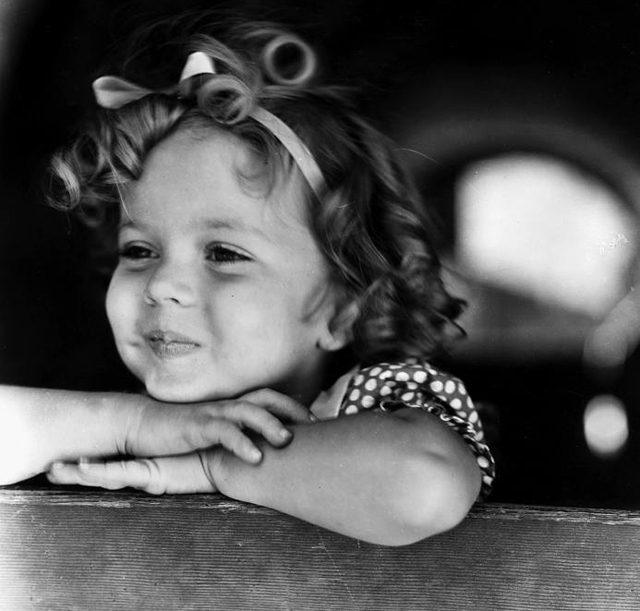
Looking for profile shots of youngsters, I found Shirley Temple in three-quarter profile, another popular pose.
Profiles seem to have come in and out of fashion in portrait styling. In the thirties they were popular for actresses. If the subject had a particularly distinctive profile, it was the signature pose as with Barbra Streisand and Alfred Hitchcock.
This photo was stuck in my brain somehow as profiles of the women, but when I found it, I realized it's more the classic three-quarter shot. It was in an Annie Leibovitz book which I had on my coffee table for many years.
Annie Leibowitz
As I was in the grips of Google, looking at famous women's profiles, I stumbled on this lovely set of photos, admittedly off the subject for this week, but I would guess of interest to Sepians. The young woman Christine H. McConnell, a stylist and photographer, found that looking at her family photos wasn't enough to satisfy her yearnings for a connection with her ancestry; she wanted to actually be in photos with her relatives and so she staged herself in matching poses to those in her family album and this is the result. You can read more about the project at www.today.com. "A great-great-great tribute: Woman represents 7 generations in recreated family photos."
Side by side with great great grandmother
With great grandmother
Lovely idea and I'm this sure brought her much closer to these relatives - a great legacy too for the next generation.
With grandmother
With her mother
The final photo I have is a profile portrait of my sister Eilleen when she was a toddler. This is the only decent profile photo I could find in the family archives. I'd say she was 18 months or so; that sausage roll atop her head with the ringlet combination was a favorite hair-do for little ones. One of my earliest memories is sitting on the bed and almost expiring from frustration while my mother did my hair this way using a wet hair brush and her fingers to form the ringlets.
My sister was a lucky child and looked good from both sides. The photographer however, must have decided that the right side was the right side for her.
Follow the mesmerizing light over to Sepia Saturday for more ideas about the photo.
My first thought about this photo, as I can imagine others thought too, is that it's the record of a disaster. Did the parents of this child die or disappear, leaving him or her in the care of grandparents? The two older people appear devastated. They must be the grandparents, suddenly thrust into a role nobody expects. The man's eyes look strange - like they're occluded with cataracts or perhaps even blind. I usually try to treat the Sepia posts with a modicum of humor but is there even the glimmer of hope for something funny about this trio?
I considered writing a caption. Such as....."Clean and Sober" or "Born to be Wild."
But no, there's simply nothing humorous about this scene. Finally, I remembered the creepy Victorian death photos. I searched the image on Google, and this photo was present on some sites that explore the subject of the ghostly photo. The question now becomes - are they all dead? I'm sure the old man is - the morticians or photographers would often paint eyes over the closed lids of the corpse before they arranged these grisly scenes. But then, the child looks terribly stiff, and the woman looks as if she might be propped up with a post in her back.
If the man is dead and the child alive, what a horror it would be to force him to pose with a corpse. The opposite would be equally horrible. On the other hand, every culture practices it's own death rituals and the death photo might have often been the only record people had of their loved one. I can understand that. Somewhere, there are coffin pictures of corpses from the Irish side of my family. I don't have them, but I know it was a common practice for my relatives to take one last photo of the dead person. I suppose to some this might seem just as creepy as posing the corpse in a simulated living tableau.
On the first trip I made to Vietnam in 2000, before digital photography was so ubiquitous, one of our group brought along a polaroid camera. In many of the villages we visited, people would ask her to take a picture of their aged loved ones. Not exactly creepy death photos but the spirit was similar. I remember in one town about twenty elderly people were lined up for a photo, once word got around that a "photographer" was in town.
Scene from My Winnipeg
I managed finally to find something to connect with on the "creepy photos" sites - a still shot of a scene from one of my favorite films - "My Winnipeg" by Guy Maddin. Guy invented a genre - the docu-fantasy. Everything in his film has a speck of truth in it about my hometown but most of it is fantasy. Here's a clip of the bizarre scene about frozen horses heads - considered creepy enough to share company with ghost photos and death photos.
The whole film is decidedly surreal and this video clip is a good representation of the work, which incidentally fared well with the critics. Roger Ebert rated it 4/4 and in 2015, the Toronto International Film Festival placed it in the top 10 Canadian films of all time.
I bet you're wondering about the other nine? Here they are: Atanarjuat, Mon Oncle Antoine,The Sweet Hereafter, Jesus de Montreal, Leolo, Going Down the Road, Dead Ringers, C.R.A.Z.Y., Stories We Tell/Les Orders. Of these, I've only seen The Sweet Hereafter and I can recommend it highly although be prepared to weep. Here's more detail about the notable Canadian Films.
For those who don't want to watch the clip...the horse-head story goes like this. There was a fire in the paddocks at the race track. The frightened horses bolted and ran straight for the river. The cold in Winnipeg is legendary, and Guy may have exaggerated slightly when he pictured the horses almost instantly frozen solid from the neck down. There they remained, creepy as can be, frozen in the ice in a grisly show, horrible beyond imagination. And then what happened? "We grew used to the sadness," the narrator tells us. The sight stopped being repulsive and started becoming a great public spectacle - the frozen heads were fascinating and people began to take excursions out to see them. First the snowshoe clubs went out for picnics and then in a truly bizarre twist, the area became a kind of lover's lane. A romantic aura settled over the scene and it morphed into a place for romantic rambles. The final wry? cynical? comment is that the city enjoyed a tremendous baby boom that autumn.
In one last ditch run through my own photo albums, I found one photo which relates to the prompt be it ever so slightly, in that there are three people in the composition, two older, one younger. All resemblance ends there because my relatives, my paternal great grandparents with their daughter, were all very much alive and almost smiling!
Muster up a smile if you can and skip on over to Sepia Saturday for more creepy stories.