Wednesday, August 01, 2018

Stewed Donkey

We're getting ready to spend a month in Florence. I've been doing a little menu research whetting the appetite. After reading a short story in The New Yorker about a couple dealing with an emergency, I imagined a similar couple traveling together. Although this isn't biographical, I do proofread menus and cackle over errors. The rest of it is imagination.


Stewed Donkey

“Stewed donkey,” she read from the menu.
“Really?” he said, looking at her from over his reading glasses. He waited for the punch line, but she said nothing.
He flipped through the pages scanning the small print listing hundreds of Tuscan dishes.
“Where are you looking?” she asked. “You’re on the dessert page. What are you thinking—stewed donkey and gelato?”
“Ah, I found it —a regional specialty. Okay, that explains it.”
“Explains it? Maybe, but that copy sure doesn’t sell. It’d be more appetizing listed as braised donkey,” she said grinning, “As in bray-sed donkey.” She snorted an unexpectedly loud hee-haw. He cringed, looking around to see if anyone else had heard.  
He hoped that was her final cynical remark over this meal. After their last anniversary trip to Russia he’d asked her to stop criticizing and picking apart every menu. Before each meal, she’d find and correct all the spelling mistakes, expecting him to react to her sarcastic remarks. An editor, she corrected text relentlessly, no matter where it appeared.
“I can’t help it, Jerry. The words jump off the page at me.”
The constant stream of negativity, albeit funny, was wearing him down. As the vacation dragged on from Milan to Florence to Palermo, the Costco-sized bottle of Tums he’d packed was dwindling. His occasional indigestion had morphed into full-time gastritis and unlike most tourists in Italy, he was losing weight. As he sat listening to her, he could feel the lining of his stomach slowly dissolving. He watched her twirl a lock of her blond hair in that compulsive way he found so juvenile.
Why rip everything apart? He felt they should appreciate that restaurant owners attempted to translate for their English-speaking guests. Yes, chicken chest instead of chicken breast was hilarious, but it was only one word. She put too much importance on little things. These were menus— not the declaration of independence or instructions for opening a parachute. In his opinion, she jumped on details to gratify her own ego.   
He thought of himself as taking a broader view of the world.
“How good would you be at translating English menus, to...say, Chinese? Cut these folks a little slack,” he said. “And after all, it really is donkey they eat. You think it’s unappetizing but others might say it sounds delicious.”
“Hah! Look around, Jerry. Most of the people in here are tourists. For them, don’t you agree they could make it sound a little better? It’s just so damn half-assed.” She grinned, waiting for his reaction to her pun. “I say, dress it up. How about Ass braised with fennel and figs, drizzled with a red wine reduction and served with stuffed zucchini blossoms? They’d get thirty-five Euro a pop instead of seventeen.” She looked smug. He didn’t respond.
“And about translating into Russian?” She scratched her head. “That reminds me of that place in Moscow—you remember— they translated “assorted ice cream flavors” as Ice cream in the ass. As I recall you laughed hard at that one. It’d be the perfect dessert to follow bray-sed donkey,” she said. For weeks after their return from Russia, she looked at ice cream menus and muttered—”no ice cream in the ass?” He’d despaired that she’d ever quit.
When they first met, he’d found her witty and amusing. But over the years this menu thing had worn thin. So thin he’d considered making an excuse to skip the trip and stay home. Right now, he thought, I’d be calm—sitting in the kitchen eating Campbell’s soup and microwaved macaroni and cheese. The idea of eating alone usually snapped him back to reality and made him thankful for his wife. But at this moment, the solitude was attractive. Alone, he wouldn’t be popping Tums and squirming with embarrassment. He’d have the cats for company. They purred when they saw the copy on the cat-food cans.  
He’d talked to his friend Rod about his feelings.
“Jerry,” Rod said. “Surely you know this happens to all couples. The very thing that attracts you at first ends up repelling you as time passes. The novelty wears off! Hang in there. She’s wicked funny and you’ll find joy with her again.”  
The joy, as promised, hadn’t returned. Instead, he’d grown less and less tolerant and could swear she was becoming more abrasive. She was sitting with one foot tucked underneath her again—she knew that annoyed him. Any minute now, she’d take out that horrible silver toothpick and start poking around her molars. In public! Once, he’d suggested she cover her mouth in the European way, as she picked and prodded herself. She’d erupted in anger—accused him of being effete and prissy.
He glared at her as she bent over the menu hunting for errors and imagined her sitting on the john in a cloud of her own farts, searching for typos on the toilet paper labels. Sharing a bathroom with her in Europe without the civilizing benefit of exhaust fans had killed the last scrap of romantic interest he felt for her. He dreaded what was coming later. She'd order the donkey, of course, so she could dine out on the story. What havoc would the equine meat cause in her mean-spirited digestive tract? Perhaps the donkey would get his revenge. He gestured to the waiter for more wine.

Hee haw, he thought. It would be a long and noisy night at the Hilton.


Sunday, July 29, 2018

One of those weeks!

I woke up this morning smelling bacon and wondered why Richard was up, making breakfast so early. The aroma was from the smoke from yesterday's fire lingering in the air. Our wonderful firefighters appear to have the blaze under control although people are still evacuated and some of the roads closed. People who have horses and other large animals have the worst of the evacuations having to trailer panicky animals and move them (with food) to temporary shelters. The electricity was off for a few hours and that was our only inconvenience although I'm still shaking off adrenalin. My anxiety goes through the roof when fire is nearby having had several near misses. At last report, the fire is sixty percent contained and has burned three hundred and sixty-five acres according to the Facebook page called Brush Fire Partyline/San Diego North County, which provides a ton of information.
Photo from our local paper, The Village News

As Richard was in Fallbrook when the electricity was turned off he couldn't get back in through our gates. I finally learned how to open them in case of power failure. The incident served as a reminder to restock the emergency boxes...with insurance documents, a copy of our address book, spare credit cards, memorabilia...and have them ready to go when we're next evacuated. 

It's been one of those weeks you hope never happens. My car failed to start when I was parked in the shopping center lot which has a seven-foot clearance. It's very difficult to get towed out of such a lot. After two days on and off (waiting for AAA to get a towing vehicle for low clearance) we were able to get the car going with the help of a kind man from BMW who drove to the car with us and got it going. No charge. They performed an all-points inspection on it, washed it, did some recall wiring work and returned the spanking clean vehicle to me. No charge. 

And the worst thing that happened. A friend in Canada who's been suffering with ALS for two years, died, at the time of her choice, Saturday morning. Even though we knew her death was imminent and even though we knew of her plan to check out when she'd had enough, it was unsettling. She's the first person I know to have chosen her exit in this way — it's called MAiD (medical assistance in dying) in Canada. She was a lovely person, generous and talented.

I met her in HoChiMinhCity at 1:00 a.m. many years ago when I arrived there to do a food tour with her company, Lemongrass Tours. I couldn't believe she came to the airport so late to meet me! Who does that?? She was thoughtful and kind. It's hard to believe she's gone. RIP Annie.

"A Parable of Immortality"
by Henry Van Dyke

I am standing upon the seashore.
A ship at my side spreads her white sails to the morning breeze
and starts for the blue ocean.
She is an object of beauty and strength,
and I stand and watch until at last she hangs
like a speck of white cloud
just where the sea and sky come down to mingle with each other.
Then someone at my side says,
“There she goes!”
Gone where?
Gone from my sight . . . that is all.
She is just as large in mast and hull and spar
as she was when she left my side
and just as able to bear her load of living freight
to the place of destination.
Her diminished size is in me, not in her.
And just at the moment
when someone at my side says,
“There she goes!”
there are other eyes watching her coming . . .
and other voices ready to take up the glad shout . . .
“Here she comes!”

Facebook Post

There's a great Facebook page for people with acoustic neuromas—Acoustic Neuroma Friends. It's like a never-ending twenty-four hour a day support group where you can find answers to all kinds of tumor-related questions. One thing that's quickly revealed by reading the posts is that everyone reacts to this situation differently and all recoveries are different—some people cope incredibly well, others are left devastated for the rest of their lives. 

I liked this very positive post by Kevin Watts which speaks volumes about having such a tumor when you're young. What a recovery he's had! In a later post, he states that he's back to music and has adapted to his SSD. 


Post by Kevin Watts
For the newly diagnosed:
Hi all, I thought I’d take a moment to share my story and philosophy with you, ESPECIALLY for the benefit of those of you who have just been diagnosed, are scared and are wondering what the road forward looks like.
The top picture was taken two days after my surgery in Dec ‘16 to remove a 4.2 cm AN. I was scared, sad, and contemplating my new normal. Single sided deafness, paralyzed face, dry eye, persistent headache and the inability to walk. All alone in my hospital ward, I did not know how I would end up. It was a rough time.
Fast forward to 18 months later, the bottom pic, and I want you to know that you get better. And IT gets better. I’ve never been stronger, fitter and maybe even happier. They say that the difference between who you are and who you want to be is what you do. In my case, I decided to meet my highest suffering with my highest hope. I trained my body daily and my mind as often as possible, to deal with my new normal. I sought out the right books and podcasts, tried to eat the right foods, found the right trainers and promised myself to never force my body to ‘recover’ again. Instead, lesson learned, I was going to shift to the front foot this time.
These are the things that worked for me, and I know that my condition, situation, and experience may be vastly different to yours and others; but the point remains - I got through it, and so did others, and so will you.

We have been dealt a strange hand, those of us with these rare and exacting tumours. There is irony in it, as even in the greatest of horrors, irony is seldom absent. As for me - I think of the scorching irony of life to take my hearing, being a musician and a former pilot. It is a reminder of the paradox of life in general. How strong and fragile it is at the same time. How cruel but rewarding at the same time. And because it is both, we get to choose which of those two meanings we want to ascribe to the irony. And that’s the greatest lesson I learned in all of this.

*******************************************************************************************
I 

I wish I could post before and after pictures of myself showing an amazing recovery like Kevins. Mine has been pretty good, much better than many others treated by radiation but the older you are at diagnosis, the longer the recovery, if at all. The biggest challenge for me—the most difficult to cope with has been single sided hearing. My new earrings may help. I wear the NO earring on my left side and the YES earring on the right side. 

Friday, July 20, 2018

Heat disaster!


Heat disaster!! Prolonged high heat devastated our baby avocados, next year's crop. The temperature in our grove was 114 degrees on July 6th and reached over 100 degrees for several days in a row. The avocado leaves burned up. Our grove looks like a madman ran through it with a flamethrower. One side of a tree can be burned and the other looks green and lush. We saved our potted plants by moving them into the shade and watering three or four times during the day. A few bougainvilleas died; the dragon fruit, roses and passion fruit look terrible and may not make it. The pomegranite trees and the succulents loved the heat. 

Our trees were too big for efficient watering and picking so it was time to either radically prune them or stump. We've chosen to stump all 850 of them to about 5 feet high. Water use goes down radically because the trees have no canopy which is where water loss occurs.  We have to be very careful about irrigation because root rot is a danger. Fertilization can be stopped until regrowth appears. 

We'll miss the forest the grove has become with the huge tree canopies meeting overhead to create a park-like area below. But it wasn't very practical. Birds and critters that have made their homes in the trees will have to move over to our neighbors. 

New growth should appear in six months. 


Sounds like rain as the baby avocados drop from the trees. 

Can you see a couple of avocados hanging on for dear life. We're keeping a scattering of trees around the house for
privacy.

Thursday, July 19, 2018

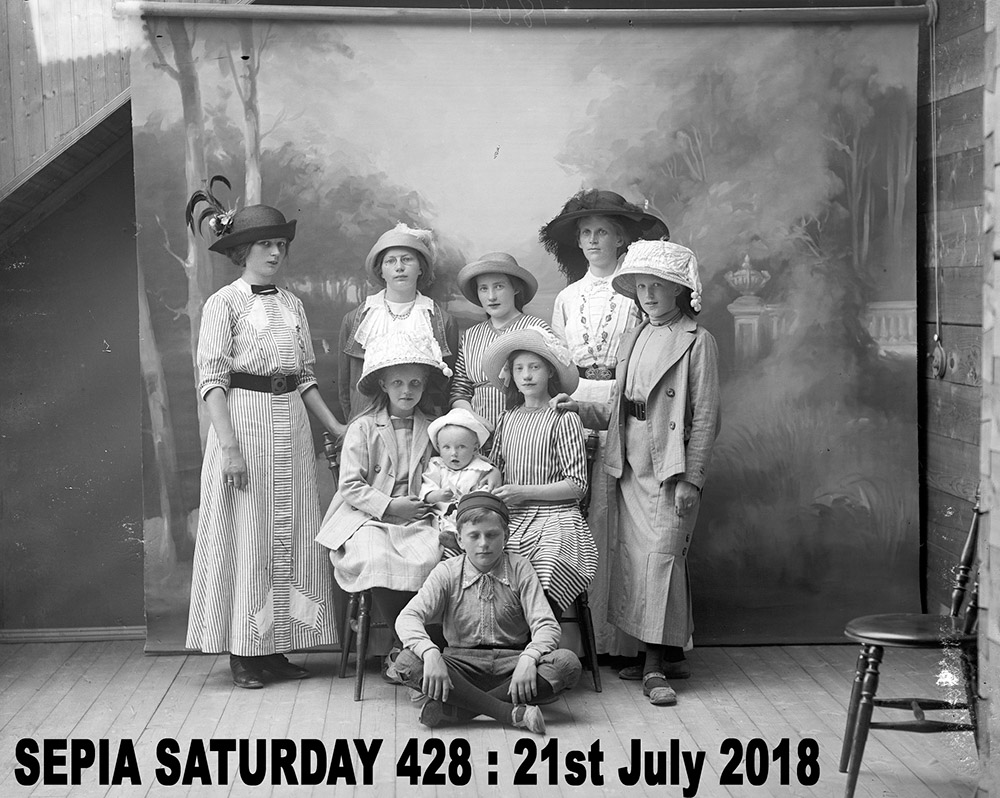
Sepia Saturday #428. Hats!

Maybe this is a cheap shot. I love the original photo and resorted to captioning as once again I have nothing sepia to match the prompt. The photo is from a collection of Norwegian county archives. I looked through them on Flicker at Fylekesarkivet: Sogn og Fjorda and found them fascinating. Don't go there unless you have an hour on your hands. 


I do have contemporary hat photos. This one was taken in Seattle where all four of us bought Tilley hats, prior to boarding an uncruise. I've never worn mine as I only cover my head in the heat and a black hat? What was I thinking? I got swept up in the shopping frenzy. The sales people were excellent. The hat languishes high on my closet shelf gathering dust and will probably end up at the Angel Shop in Fallbrook. The other three made better selections and use them often.


The last photo is my French-Canadian grandparents who lived on a farm in Letellier, Manitoba in Canada. I included it because of the background. And to be fair, I added a caption. My grandmother always did the talking if English was necessary. My grandfather understood but spoke little English. Instead, he used his generous eyebrows to convey his opinion when English was being used. 

Grab your hat and dash over to Sepia Saturdayfor more interpretations of the theme. 


Monday, June 11, 2018


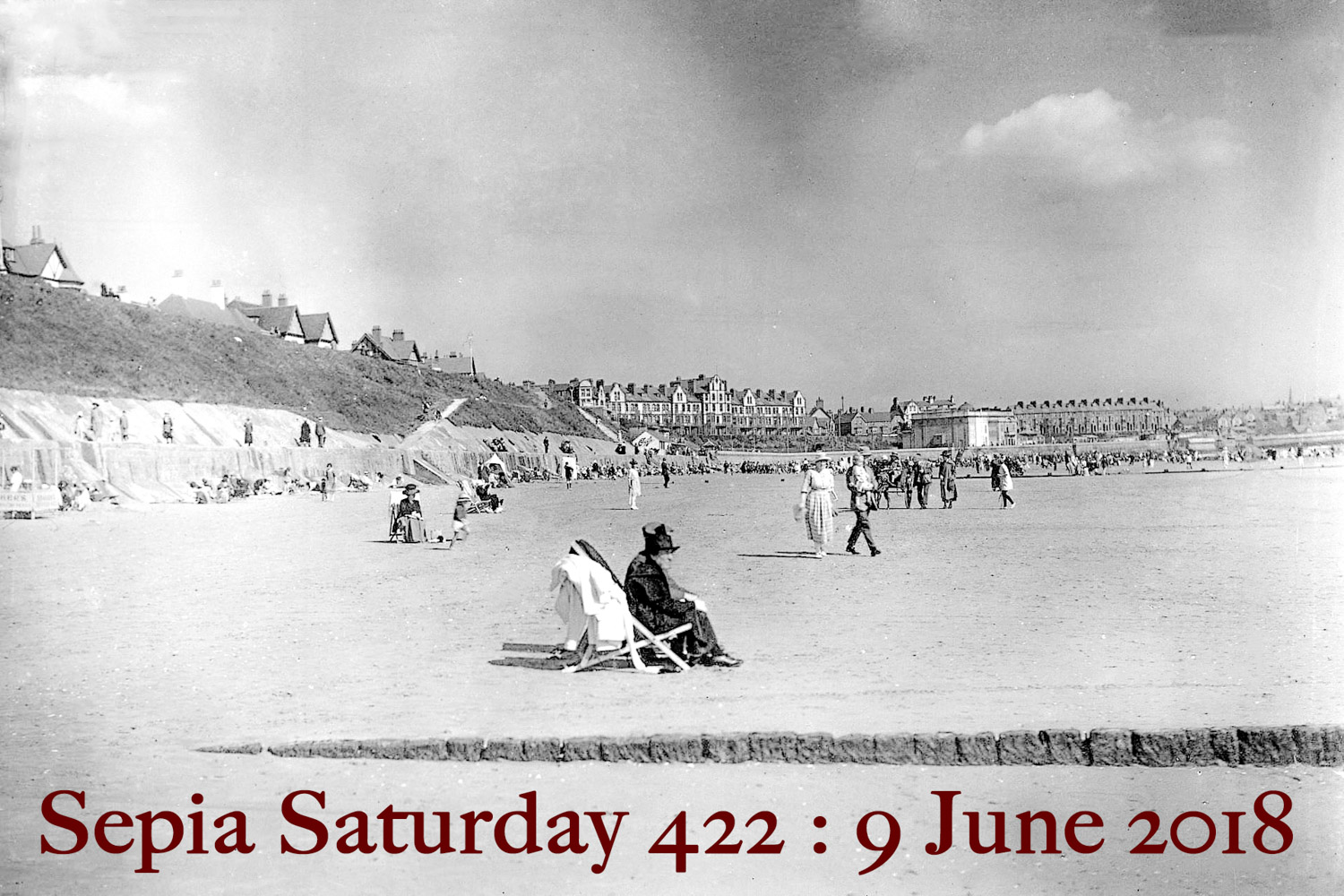
The woman alone on the beach—uh oh, I see on closer examination that she isn't alone. Someone is sitting right next to her. 

I always enjoyed going to the beach alone with a book and a sandwich. During the summer, circa 1970, I had the day off work in the middle of the week. It was July and I decided to spend the day reading on the beach in Santa Monica. I packed up my beach chair, the latest bestseller, a sandwich and a drink. It was going to be heaven. In those days you could actually drive across town from Glendale to Santa Monica in less than an hour. At 9:00 a.m. I was all set. The fog had just lifted; there were a few people on the beach, scattered here and there. I nestled into the sand and began to read.

After about half an hour of bliss, a man carrying all his gear—blanket, chair, cooler—walked over to three feet away from me and spread out his blanket. What? I thought. There's a whole empty beach here, but the guy had to get into my space. Just as I was thinking of getting up and moving, he took all his clothes off and ran, stark naked, into the water. I gathered my things to get out of there, fast, when I heard a siren. It was the lifeguard in his beach jeep. He called the man out of the water and walked him back up to his clothes. The man didn't speak English—I couldn't make out the language—and seemed puzzled and alarmed. He pulled on his clothes and the lifeguard walked him back to his car. Nobody said a word to me. I sat back down and enjoyed the rest of the day. 

I've never forgotten that man and his predicament. I concluded he was probably a European tourist accustomed to swimming naked. And I've thought about myself as an uninformed tourist, stumbling around in foreign countries, probably being unwittingly offensive now and then. Fortunately, my cultural faux pas never set off alarms. Not yet. 

In the prompt photo, I hope the man sitting next to the woman is with her, as in her companion, and not a naked stranger, as was my experience.

I have no sepia photos to match the prompt, only a memory. But here's a couple of beach photos. 


Richard, almost alone, in Santa Monica. About 1970.
Goa, India, before the crowds. 2012. 
Better late than never.....see the on-time Sepia contributions at Sepia Saturday

Thursday, June 07, 2018

The locksmith limped over to me. He scooched himself out of his van with visible difficulty. When he got over to the lock and we introduced ourselves, he made a comment about his amputated leg. 
"Gangrene," he said, pulling up his pant leg and exposing the prosthetic leg. "Took it off just below the knee."
"Oh no," I replied.
"It started out with a small infection, got bigger and finally gangrenous."
"How long ago?" I asked.
"It's been a little over a year," he said."Got it done half-price, in exchange for encouraging for a couple of young people who my surgeon was treating. Kids who wanted to give up and not even try."

Richard and I had just watched Fargo again and the image of the foot sticking out of the wood chipper popped into my brain. I wanted to ask him what they did with his leg. Somewhere I've read, people have ceremonies and lay body parts to rest. But I didn't get the chance because he kept on talking for twenty minutes non-stop as he repaired the lock. I'd asked him what his geographical range was.
"I go to Beverly Hills," he replied.

Seems he has celebrity clients whose locks he's done for decades—people who have Emmies and Oscars in safes. For whom he has signed confidentiality agreements.  He told me a few stories I won't repeat. But who would guess a locksmith's life could be the source of so many stories?  He'd been approached by paparazzi to reveal information about some of "his people," but his lips are locked. 

He told me he'd opened a safe and found an anaconda snake inside. Another one contained explosives. Another a cache of weapons. Another was stuffed with illegal drugs. These were safes of people who'd abandoned their homes for whatever reasons. Sometimes law enforcement was involved. 

A one-man operation, he's never had an employee and he's never gone a day without work. He showed me a ring of keys marked McDonald's. He handles all their locks in the Temecula and Murrieta area. "Once you're in with these people—you're in forever," he said. I got his card at the Temecula Post Office. They had a one-inch thick stack of them. 

Finally, he told me he's never run into a female locksmith and we discussed the pros and cons. I googled, "Is being a locksmith dangerous?" and found this well-written blog post. 

The locksmith trade ~ The good, the bad and the ugly

Are you thinking about becoming a locksmith? Many people ask me about my profession when I arrive at a job site. The idea of working with the public, working with hand tools, making a quick buck on lock-out calls, and of course the power and ability to unlock doors, cars, and safes is quite intoxicating for some people. I don’t place help wanted ads, but nevertheless, I average one unsolicited résumé a month via e-mail. Usually, it arrives from an eager teenager looking to do an apprenticeship. O.J.T. (on-the-job training) is a fine way to go if you can get the gig. That’s precisely how I started. That and reading every trade magazine I could get my hands on, endless hours doing research on the web, taking classes, attending trade expos, and talking with any locksmith who would take the time to chat with me (and many would, so long as I wasn’t one of their competitors). But that’s how it is for most lock jocks. Once you begin work as a locksmith it gets under your skin. It consumes you and becomes an obsession. That’s not exactly a bad thing after all; to be (God willing) financially successful at what you enjoy is a great way to pay the bills. There is, however, a price to pay that does not fit with most people’s lifestyle, and thus — the purpose of this article.
The Good: Helping the public and making a few bucks while doing it. First off, I rarely charge to unlock a car or house when there is a child locked inside. When I get the call, usually from a panicked parent declaring his or her child is locked inside a car, I rush to the scene. There are few better moments for me as a locksmith than seeing the relief in a mother’s eyes when I unlock the door and she pulls her child from a sweltering car on a warm summer day. “You’re my HERO,” she says as she holds her child close with tears in her eyes. “No charge ma’am. We don’t charge for children locked in cars. If you like, for a small fee, I can make you a copy of your car’s door key so it’s less likely to happen again.” They almost always say yes, and the payment for the key usually accompanies a tip. The “up sale” is simply to cover my gas going out on the call, and the tip, if any, buys me lunch.
The rest of my jobs are typically for-profit jobs. Still, over half of what I charge goes right back into the company in the form of gas, insurance, advertising, trade organization dues, license fees, vehicle maintenance, tools, supplies, and other expenses.
As a locksmith, you will never get rich, but if you play your cards right you could retire well. The plan, as I read in a popular trade magazine, is to sell a well-established shop with a long list of customer accounts, while owning and collecting rent on the property the shop sits on. It’s even better if you own an entire complex and collect rent from your shop’s neighbors, too. I personally know a retired locksmith who did exactly this and I understand he is doing quite well for himself.
Many locksmiths make and sell tools and/or reference books, or teach classes (as I do) to supplement their income.
The Bad: Being on call 24/7. After-hours and weekend service can account for a large part, if not most when first starting out, of your income. Then there are the late night calls. 2am, half drunk and he can’t find his car keys: “I’m sorry sir — I can’t help you drive your car tonight, but if you call me in the morning I will be happy to assist you.”
The locksmith industry is a highly regulated (but necessarily so) security industry. The licenses, insurances, and bonds you have to carry can cost a small fortune. I have a city business license, a state locksmith license, a State Contractor’s License for lock and security work, two insurance policies (general liability and commercial vehicle insurance), two different bonds, and I am a member of two major national trade organizations. In California, you need to be fingerprinted and pass State and Federal background tests. I am also a member of some local organizations including the Chico Chamber of Commerce and the North Valley Property Owner’s Association.
The cost of running a business like this can be overwhelming and there is always another tool you need to buy, another software update, or replacement parts/tools that need to be ordered. I am currently saving up for a high security key machine that retails for $5,800.
Let’s not forget the paperwork. You will need to keep legal forms for customers to fill out and detailed records of who, what, where and when. The last thing you want to do is make keys to a car or house for someone who does not have authority to hold a key to that property.
Lastly, buy a nice shirt and tie because there is a good chance you will find yourself in a court of law before long for, among other things, domestic disputes.
The Ugly: Evictions, repossessions (R.E.O.’s), and re-keys after a domestic dispute. There are few things as humbling in this profession as writing a bill for after-hours service and handing the new keys over to someone wearing a fresh black eye. I vividly remember one woman who was standing next to a hole in the drywall where her head was forcibly inserted only a few hours earlier. The local sheriffs know me because it’s not uncommon to perform the re-key and security checks while they are still there, filling out their report.
Can you say fleas? Yep, now I keep flea powder in the van because you never know what condition a recently foreclosed house will be in.
Angry former tenants who have been kicked out can also present a challenge. Sometimes the locks are disabled or destroyed, and I keep latex gloves in the van in case I ever have to pick open another lock that has been urinated on.
The bottom line: I am quite happy being a locksmith, most of the time. The pay, the freedom of the job (I can leave my schedule open if my kids have a school event), and the satisfaction of helping people while making a profit for myself keeps me going.
My advice to you:
1. Do your research before entering the market as a locksmith. My town has too many locksmiths per capita. There is barely enough work to go around much of the time.
2. Get on with another locksmith and be willing to relocate, as you may be required to sign a “no compete” contract saying you will not leave to be your boss’s competitor. Locksmith schools are okay, but a seasoned locksmith can show you some tricks of the trade that can help you make higher profits or perform jobs better and quicker than the basic skills taught in most schools.
3. Be willing to pay your dues. It will take many years to build up a customer base, and a name for yourself. A wise locksmith once told me it takes at least three years before they (the customers) know you’re there, and seven before they notice you are gone.
4. When you start out on your own, get an easy to recognize logo and put it on everything: your van, invoices, pens to hand out, and every other piece of advertising (see our logo below).
5. C.Y.A. Document everything and have pre-printed, professionally prepared, legal forms for your customers to fill out.
6. Don’t get too carried away. If you have other obligations, like a spouse and/or kids, make sure to make time for them. It’s hard to turn the phone off, or turn down calls because you’re turning away money, but you can’t get back the days you miss.
A former employer of mine occasionally tells the story of how he made $2,000 in one weekend dispatching calls to his on-call locksmith, while he was on a boat on Lake Shasta with his wife. It was a rare weekend vacation for them and he spent a good part of the day on the phone. She died of cancer two short years later, and he later told me he would give just about anything to have that day back. I know this story personally as I was the on-call employee that weekend.
To quote Uncle Ben (from Spider-Man, the movie): “With great power comes great responsibility.” The ability to unlock doors, bypass alarm systems, unlock safes, and the inside knowledge of customers’ security systems has been the downfall of unscrupulous locksmiths. In short, if you can’t handle the temptation, don’t pursue the profession.
Finally: Never take advantage of someone. Like Grandpa always said, it can take a lifetime to build up a good reputation but only a moment to ruin it.
Good luck in whatever you decide — unless, of course, you are planning to open a lock shop in my service area.

~Michael D. Meyer – Owner
AllAboutLocksAndSafes.com
Mobile Locksmith Services
Chico, CA
(530) 514-0252

Thursday, May 31, 2018

Overrun

This article was in a newsletter I get from Escapes Unlimited, a small travel agency in Orange County I've used a couple of times. 

And they don't even mention the horrible onslaught of massive cruise ships everywhere. And they don't mention how the lovely Balinese town, Ubud, has been turned into a zoo since "Eat, Pray, Love." Tour buses bear down on the place every day to the point where there is gridlock much of the time. The way of life has radically changed and the culture. I doubt I'll ever venture back into the town. Fortunately, there are still places on the island you can escape the crowds but for how long? 

I think of how our town would be if overrun with tourists —like it is for the Avocado Festival—every day. The last time I was in Laguna Beach will likely be the last time. No parking, crowds everywhere. Tourist buses. And not even during the Art Festival when you might expect the mobs. 

                                                                    ***

The Wall Street Journal recently had a story about the increased number of tourists that target the top vacation destinations worldwide. (May 22 by Rachel Pannett). Tourism is a mega-industry that has grown significantly due to the rise of budget airfares, more social media awareness that make distant places easier to navigate and an emerging Chinese middle class that now travels extensively. In Venice, Mallorca, San Sebastian and Barcelona there were anti-tourist demonstrations last summer. Tour groups had to be banned from parts of those cities.


It’s a difficult situation, especially for Third World countries that need the money that tourism brings but don’t want their special places over-run or destroyed. Cambodia and parts of Africa fall into that category. Thailand is talking about closing Koh Phi Phi island for part of the year. New Zealand has started a dialogue about restricting tourists by limiting Airbnb’s and Wifi. They attribute the increase in tourism to the “Lord of the Rings” series. Ten years ago New Zealand worked hard to get more tourists before the movies came out. Now it’s hard to find hotel space.

Chinese tourists numbered 20 million a decade ago. Now there are 60 million traveling to the world’s most desirable destinations which include many European cities, and parts of Southeast Asia.

Locals want tourists to be more sensitive to their culture and environment, be more aware of what behavior is appropriate. For example, in Bali, people never raise their voices, yet I’ve heard tourists from various countries scream across a hotel lobby for their spouse or fellow traveler. The Balinese just freeze in place when that happens. It’s so contrary to their way of life.


HAPPY TRAVELING! 
Roe & Daniella
Escapes Unlimited
2012 Lerner Lane 
Santa Ana, CA 92705 
800 243 7227

Monday, May 21, 2018

Sepia Saturday 419: Safe on a Rock!


The photo prompt this week shows a daring group seated on a precarious rock. 

My prairie-bound family liked things flat—the flatter the better. A mere mound in the landscape made my mother nervous. When she visited S. California and the mountains blocked her views, she was like a skittish cat. The only time she fully relaxed while visiting was at the beach, where she could see the open ocean. 

There are no photos of ledges or lookouts or mountain climbing in my photo boxes. No thrilling moments were captured either. For our risk-aversive family, the Tilt-A-Whirl at the Royal American Shows was skirting the edge of dangerous. Reasons for not riding it included the possibility of it flying off the rails, tipping over and crushing somebody; vomiting; permanently damaging your equilibrium.  


What I do have is this photo of me and my fellow CGIT'ers, Canadian Girls in Training, on a rock, at the Brereton Camp, Whiteshell Provincial Park, 1955. We were thirteen. I'm in the front row, left, looking like a ten-year-old. 

It was probably this camping experience that turned me into a hotel gal for the rest of life. Using a stinky outhouse and hauling water wasn't my idea of a good time. The water in the morning for face washing and teeth brushing was shockingly cold. Night noises from the bush were scary.

This cartoon comes from the Alberta CGIT website. A new body image for the girls? Our leaders wouldn't have tolerated drooping socks. Our middy blouses had to be clean and neat. The friendship knot in our ties had to be correct. In my memory, the guides were leaders, but not tyrants. 


I had to get a special dispensation from our priest in order to attend the camp because it was a Protestant organization—as if my Catholicism was so tenuous that I could be co-opted in a week.  Actually, they were right! All my friends were Protestants and could take care of their religious duties in an hour per week. I envied them. No confessions, no Holy Days of Obligation, no fasting, no penance. At church, no kneeling, no Latin, no suffocating incense. The United Church, where I attended CGIT, was light and airy compared to our Catholic Church, dim and scary with curtained confessionals, strict unsmiling nuns and stations of the cross hung with bleeding, suffering Christs. As I recall, I was excused from the religious ceremonies at the camp.

At this age, I rarely smiled in pictures. A cousin told me I was going to be buck-toothed and I may have been trying to hide whatever it was he saw. Almost fatally homesick; this was my first time away from home for a week. My life-long friend Linda is at the other end of the front row and she looks happier than me. Looking happiest of all, is Fish—aka Mary Ellen Cuthbert—back row, right. Look at her upturned collar; her hand on her hip; legs jauntily crossed in a studied pose.  I've written about her before. She was an outstanding character in our midst. A gal with a reputation later on in our teens. I can't imagine she was a bad girl at thirteen, but maybe. The photo here portrays a great deal of self-confidence, the exact opposite of me. I hope that confidence worked well for her for the rest of her life. 

The Ode came from the camp website and brought back a lot of memories. 


Ode To C.G.I.T. Camp Brereton, 1937-2007 

Way back in the ‘30s this camp was begun 
By women and men, who, when they were done, 
Had built here a lodge, and a cabin or two, 
For campers and leaders like me and like you. 
To get here the campers then traveled by train, 
They walked from the tracks in the sun and the rain. 
In the 40’s they bused it right up to the door – What an improvement; could they want more? 
In the 40’s and 50’s the lodge was quite small, 
Can you believe, there was no dining hall! 
We ate in the lounge, and then should it rain, 
We’d collapse all the tables, then set them again! 
The water, we hauled it all up from the lake, 
No showers or flushes, and make no mistake 
We extinguished our lanterns when time for “lights out”, 
And we needed our flashlights to wander about! 
In the mornings we hurried to be first in line 
At the biffy – no privacy – three at a time! 
A wall at the end gave the leaders their side, 
“Twas just a two-holer- they sat with pride! 
Below the rock ledge you can now reach with stairs 
The cabins were arranged mostly in pairs, 
Please take the time to check out old Cabin 7, 
It’s just storage now – we thought it was heaven! 
Six bunks to each cabin arranged ‘round the wall, 
Each cabin with one leader, her whistle and all, 
Our leaders were given affectionate names, 
And mostly they all went along with the game. 
The ledge where your cabins now proudly reside 
Was called Council Rock, where our Pres. would preside 
Over meetings; and then, Bible Study was shared, 
And much more, as for campers and leaders we cared. 
If we wanted to paddle our own canoe 
We had to swim to the island and back again too, 
Off to the Ridge we would hike as we sang, 
And our voices would echo, and all the woods rang! 
International Camp Council was here in ’85, 
With 72 or us on site, it really came alive! 
From Nigeria and Trinidad, and yes, Bermuda too – Our “pathways” crossed at Brereton, and friendships came and grew. On our 50th we had a ball with campers re-uniting, 
The singing, laughter, fun and all was really quite exciting! 
And Cabin 1 has been improved, it’s own bathroom and ramp 
Have helped to make our Brereton a fully accessible camp! 
New roofs, and walls, and holding tank, a pump, canoes – a “Tree” Have all been added to this place – most, of necessity! 
But these aren’t the things that matter most, there’s a Magic that we see 
As girls and leaders share and grow into the persons God wants them to be. 
For 65 years at Brereton, we all can give a cheer 
In joy and praise and gratitude, that we still gather here. 
Our Tree of Life, and the names upon it, is a symbol of love for this place, 
God has blessed us richly ‘thru the years – we say “Thank You” for this gift of grace. 
So take your neighbor by the hand before the evening’s end, 
We want to bow and say a prayer to our never-failing Friend… Thank you for the Past… Thank you for the Now. Be with us as we grow to become the persons you would have us be. Amen. Addie Thoroski, Pat Finlayson July 1997, June 2002

Check out other Sepia Saturday stories HERE